
The Zero Point Field
- Details
- Written by AndEl
 Chapter 4
The Invisible Field
Quantum science in the 20th century revealed the presence of an all-pervasive background sea of quantum energy in the universe. Cambridge University’s Dr. Harold Puthoff was one of the first to measure this energy of the universe. This energy was measured at zero degrees Kelvin, the absolute lowest possible temperature in the universe equal to minus 273 degrees Celsius. At this temperature according to Newtonian physics all molecular and atom movement should have ceased and no energy should be measured at all! Instead of finding no energy, as was expected, he found what he called a ‘seething cauldron’ of energy and henceforth it was given the name zero point energy (ZPE). Harold Puthoff proved that the physical vacuum is not devoid of energy at all and that instead of being a vacuum, space it is actually a plenum.(1)
In quantum electrodynamics the background sea of quantum energy is now used to explain the uncertainty principle that was discovered by quantum physics, the unpredictable behaviour of subatomic particles. The jiggling of subatomic particles is believed to be caused by the zero point field. Randomly virtual photons jump back and forth between the zero point field and our physical world. They collide with and are absorbed by subatomic particles that will be excited into a higher energy state. After nanoseconds the energy is released again by means of another virtual photon that returns to the zero point field. The photon is called a virtual photon since it comes and goes from the zero point field and is not here to stay in the material world. It is only used in the energy exchange between the zero point field and the material world.
Not only photons but also all sorts of elementary particles come into our physical reality from nowhere at all. They seem to come from the zero point field, make their appearance in our physical reality for only thousandths or millionths of a second to disappear once again into the void. These forms of mystical particles were called virtual particles since they were not stable enough to stay around in our reality. The zero point field is a quantum foam of virtual particles and photons. Our universe is never at rest not even in empty space!
Even in a pitch-dark room where absolutely no light from the outside world can penetrate, scientists can still measure the presence of virtual photons.
The existence of the zero point field has been known in the quantum science community for a long time, but most scientists simply ignored its relevance. They simply nullified the effect of the zero point field energy in their scientific calculations since it only bothered them. As a result they eliminated the effect of the zero point field because they believed the effect was insignificant!
However a small but growing number of scientists now take the zero point field very seriously, among them are many professors of note and they are now taking on a radically different view of our reality. Their scientific discoveries and theories are controversial in the eyes of the established science community who are holding on to the old paradigm that our world can and eventually will be fully explained by a mechanical model of the universe.
The zero point field is becoming popular to a larger public thanks to scientific journalist Lynn McTaggert who wrote the book ‘The Field’. She created greater awareness of the zero point field that may otherwise not have been disclosed to the public at large. I strongly recommend this book to anyone interested in new zero point discoveries and the astonishing role human consciousness plays in this field. For paranormal and psychic phenomenon, there is now a scientific basis for study.(2)
One of the first magazines covering the zero point field at length is Ode which appears in the US and the Netherlands. The article about the zero point field appeared in the November 2003 issue, no 61. (3)
A Sea of Energy
Princeton University’s John Wheeler and Richard Feynman valued the zero point energy for the first time. They calculated that a cup of zero point energy is enough to bring all the oceans of the world to boiling point. The equivalent in matter of the zero point energy using Einstein’s famous equation of E= m * c² is 10⁹⁴ gram/cm³! This is more matter per cubic centimetre than the total mass of the entire universe!
Contrary to what we have always believed matter is not a condensed substance but a diffuse form of energy.(4)
Now how is this possible, we seem to live in a huge sea of energy and we don’t even notice it? We’re like fish submerged in water but never ever aware of the fact that there is water all around them.
Haisch and Rueda contributed to the zero point field using Hal Puthoff’s work, by proving Newton’s famous law of inertia which states that inertia is the product of mass and acceleration, F= m * a. This old law that Newton took as an assumption, an axiom in his Principia, the holy bible of classical physics, could never be proven in the last three hundred years! But by taking account of the zero point field, Rueda and Haisch proved that inertia is simply the resistance, the drag that objects experience when accelerated in the zero point field.(5)
Sonoluminescense
There exists a very weird phenomenon in nature that is called sonoluminescense; it is the transformation of sound waves into light energy! It is well known experiment in mainstream physics.
In the experiment a small spherical glass, filled with water is resonated by harmonious sound waves of 20 KHertz originating from sound speakers. Next a very tiny air bubble is blown into the center of the spherical glass flask. When the air bubble is exactly centered in the flask it starts to rhythmically implode and emit light. The light is emitted in ultra short light flashes representing trillion-fold concentrations of the original sound energy. Temperatures within the center of the bubble reach an astronomical height of 30.000 degrees Celsius and the pressure is immense.
Mainstream physics is still having problems with this experiment and are speculating about cold fusion, others think that there is no other explanation than that the abundant light energy comes from the zero point field! The sonoluminescense effect has stimulated the imagination of Hollywood filmmakers, and they featured a whole film about this phenomenon, the film is called ‘Chain Reaction’.
Further investigations about this natural phenomenon may lead into what is called sonofusion, a kind of cold fusion that physics has been seeking for so long.
Sonoluminescense Experiment
Harvesting the energy
Since the word on zero point energy was out in the world, a new breed of gold diggers has been born. Many inventors are on the hunt for this zero point energy since it is free energy. The story goes that even Michael Faraday and Nikola Tesla discovered the application of free energy. Once you know how to delve it you can tap it from the vacuum in an abundance that is inexhaustible. Imagine this, your TV set having no power cable since it is running just on energy it receives from the vacuum? Can you imagine that, do you know what this means? Bye bye to oil, maybe now you get the picture. In a world that is heavily dependant on oil, many people in power today will not be pleased since they will lose all their power and wealth.
It is for this reason and the possible military applications that these inventions have been suppressed globally in the last few decades. The United States of America prohibits pending patents to be exported outside the USA if they are believed to have dangerous military applications. However retired army lieutenant Tom Bearden has patented an over unity free energy device called the Motionless Electromagnetic Generator, the MEG. Over unity in this respect means that more energy is coming out of the device than what is going into it. Bearden claims that it produces a 100 times more energy output than the energy that is put into it to keep it running. His MEG device is not in conflict with the laws of energy conservation, the second law of thermodynamics, since it simply taps the energy from the vacuum. Jean Louis Naudin who replicated Bearden’s MEG device now corroborates his claim that the MEG is an over-unity device.
Bearden has redone 19th century James Clerk Maxwell’s work, the founder of the classical electrodynamics theory. He says the interpretation of the original work of Maxwell is seriously flawed and has been misinterpreted and simplified by Lorentz and Heaviside for better understanding. Bearden discovered that the original quaternion equations of Maxwell were overlooked and, as a result, so was the possibility of tapping free energy from the vacuum. Bearden is in good company about this statement since it was Max Planck the founder of quantum physics who had always suggested that the validity of Maxwell’s equation should be re-established.
In lay terms Bearden’s MEG devices is basically a charged dipole, consisting of two charged plates. He explains that the physical vacuum creates a virtual photon flux of electromagnetic energy that sustains the electrical dipole potential. The dipole potential is actually the equilibrium between the discharge and replenishment by virtual photons from the vacuum. Hence, the static electric field is not static at all; it only appears to be so, much like a waterfall, which from a distance looks like one static wall of water, but when studied at close range proves to be a constant flow of water. The secret of the Meg device is not to discharge the charge of the dipole in the same circuit of the dipole but in another separate electrical circuit. After this the vacuum will automatically replenish the discharged dipole to seek equilibrium. The charge that flows in the other circuit is said to deliver real electrical power.
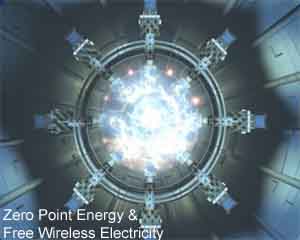
In this way zero point energy is extracted from the vacuum and discharged in an electrical circuit. Bearden says that all our current sources of electrical energy such as batteries, dynamos and power plants all have one problem in common. When the electrical current is fed back to the source that created the electrical current to begin with, it will kill the source of the virtual photon flux with the vacuum. Unknowingly we’ve been taking buckets full of zero point energy from the river but were unintentionally throwing it straight back into the river.
Tom Bearden also made a very important new discovery concerning a new type of ‘electromagnetic energy’. According to Bearden the four Maxell equations used in today’s electrical engineering are simplified versions of Maxwell’s original work. According to Bearden it was Oliver Heaviside who removed the scalar part of the complex numbers in Maxwell’s equations leaving only the vectors in Maxwell’s equations for easy calculation.
This is why science today only knows the classical electromagnetic wave that is a transverse wave. In the transverse wave the electrical and magnetic fields of the electromagnetic wave oscillate perpendicular to the propagation of the wave. Bearden says that by removing the scalar part in Maxwell’s equations we missed the fact that energy can also propagate as a longitudinal wave at super-luminal speed (faster than the speed of light). Longitudinal waves are akin to sound waves and oscillate in the same direction as their propagation.
According to Bearden the internal longitudinal wave in the electromagnetic wave is the fundamental wave and exists in all known electromagnetic fields of any shape. The scalar component of the electromagnetic wave can be created from two opposing electromagnetic waves, a wave and its anti wave. Both waves will cancel each other’s electrical and magnetic field components when the waves are in phase spatially but 180 degrees out of phase temporally The result is an electromagnetic scalar wave. This scalar wave travels in the time domain and it is completely different from the transverse electromagnetic wave, which travels through three dimensional space. According to Bearden we must think of time as a compressed form of energy just like matter is. Remember Einstein’s famous law that tells us that energy equals mass times light speed squared? Now the same amount of abundant compressed energy can be found in the time domain and can be tapped when the longitudinal scalar EM waves of the time domain are converted into ordinary transverse EM waves. The conversion of scalar electromagnetic energy into transverse electromagnetic energy is called scalar interferometry and is the result of two interfering scalar waves. It is the opposite effect to the self-cancelling of two transverse electromagnetic waves which creates the scalar wave.
The virtual photon flux that occurs between the dipole and the vacuum mentioned above is what scalar waves are. So scalar waves are very different from electromagnetic waves; for one thing they can travel over immense distances with no loss of energy at super-luminal speed (faster than light).
When scalar waves are created by a dipole, such as a battery, a generator or a permanent magnet with two poles, the polarisation of charge will create scalar waves that rush between the dipole and the vacuum. Every dipole in the universe from the atom with its positive and negative charges, to the Earth and the Sun with its magnetic fields and all the other heavenly bodies in the universe radiate scalar waves, so basically scalar waves are everywhere in the universe, they fill the vacuum of space making it a plenum of zero point energy.
In the early 20th century Nikola Tesla was the first to discover the scalar wave. He used induction coils to create these scalar waves. He had conducted many experiments while sending scalar waves around the Earth proving that scalar waves propagate over long distances with no loss in field strength. Unlike our current familiar electromagnetic wave that dissipates and looses its energy at a rate equal to the square of the distance from the source, Tesla’s longitudinal waves could travel any distance with practically no loss of energy.
Tesla in his time believed in the existence of the aether and that it could be harnessed for free energy that could be the salvation of humankind. He addressed the American Institute of Electrical Engineers in 1891 with these words; ‘.. with the power derived from it, with every form of energy obtained without effort, from stores forever inexhaustible, humanity will advance with great strides, it is a mere question of time when man will succeed in attaching their machinery to the wheelwork of nature’.
Tom Bearden’s scalar waves have also been discovered by Russian scientists. The Russians however have given scalar waves a different name; they refer to them as torsion waves. We will learn much more about torsion waves later. As a former military man, Bearden is convinced that the Russians used this technology to create an arsenal of scalar wave weaponry during the Cold War. These weapons are based on Tesla’s howitzer, a deadly scalar weapon that makes our present day weapons of mass destruction weak in comparison. In their mildest form these weapons can be used to modify and manipulate the weather, create hurricanes and tornados and can even be used to induce earthquakes. In their most aggressive application they could wipe out our present civilisation with a deadly force that is unstoppable.
On the other hand the peaceful application of scalar wave technology is beyond imagination; it is unlike any other technology that this planet has ever witnessed and may lead us into a Golden Age. It promises free energy, anti gravity propulsion, and healing applications that will cure any disease by means of time reversing the illness. According to Bearden, Antoine Priore in the sixties and seventies used a pre-cursor of his patented medical application of the scalar wave technology and Priore’s experiments on animals proved that he was able to cure all forms of cancer. The explanation for these miraculous cures is that the damaged cells are simply forced by the scalar waves to their previous healthy state. So scalar wave technology is a technology of miracles if we are to believe Bearden.
Bearden’s theory, which he has put in writing in a book called ‘Energy from the vacuum, concepts & principles’, is proven by the first marketed power device called the ‘Patterson Power Cell’, an innovative over unity energy device.
The Patterson Power Cell is developed and patented by James A. Patterson, scientist of the Clean Energy Technologies in Dallas. It is a glass enclosure filled with thousands of tiny palladium coated spheres that serve as the electrodes. It runs on heavy water. When started with a small input power of 1.4 Watts, the cell puts out an enormous amount of heat, hundreds of times the energy input. Claims are that the US Patent Office has tested it and four patents have been awarded. It’s being studied at different universities worldwide and is taken very seriously: now the dispute seems not to be if it works but how it works! (6)
Vortex Technology From Antiquity
Robert A. Patterson himself is a very remarkable engineer who has educated himself in vortex technologies and studied the work of Viktor Schauberger. Viktor Schauberger worked on vortex technologies for the Nazi’s during WOII and has made many amazing inventions that, like Tesla’s inventions, almost went down in history to be forgotten. Their invaluable contribution to science is finally recognised by pioneers now the energy shortage in this world is building to a climax. We’ll come to vortex technologies and their electrical application in Daniel Winter’s implosion physics in chapter 6 (‘Ether vibrations’). The best visualisation of a vortex is a tornado sucking in air and accumulating these whirling winds with incredible magnitudes into the center, the eye of the tornado.
Among Patterson’s inventions of applied vortex technology is a RAM implosion wing that can be attached to the roof of a car. This wing will create an imploding vortex in front of the car and an expanding vortex behind the car, such that the pushing of the rear vortex reinforces the suction from the front vortex. The overall effect is that fuel consumption is drastically reduced by a factor 2 or 3.
The drastic reduction of fuel consumption is the result of the car’s drag reduction. As a practitioner of the Chinese martial arts of Wing Chun Gung Fu, Patterson got the insight to use the energy of his opponent who takes a swing at him; by redirecting that energy to work for him, he is able to tackle the opponent by getting him out of balance from his own swing. It’s a common practice in martial arts. Using the martial arts analogy, the opponent of the car would be the sustained drag and Patterson explains that the energy contained within this drag can be redirected to do usable work. This is exactly what his RAM implosion wing is doing.
Patterson somehow realised that the same vortex pumping mechanism of his RAM implosion wing, based on the aerodynamics of air, may have an electrical counterpart in electrodynamics if applied to zero point energy in the vacuum of space. What if he could ‘pump’ this zero point energy using electronic circuitry to mimic the vortex technologies used in the design of his wing?
Now the most astonishing fact of the matter is that his next enlightened idea was inspired from yet another ancient Asian art form, a Dogu statue from Japan. He stumbled upon this statue reading ‘The Antigravity Handbook’ by David Hatcher Childress. These ugly looking statues date back at least a 10.000 years. Looking for the electronic equivalent of his RAM implosion wing, he suddenly realised that this must be it. Now you and I, if we had yet another 10.000 years time to gaze at this ugly statue, would probably never come up with the idea, but according to Patterson, this statue is the schematic representation of what he calls an electrogravitic implosion propulsion system.
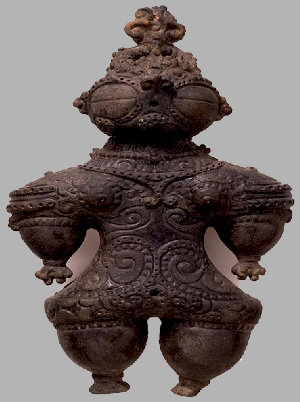
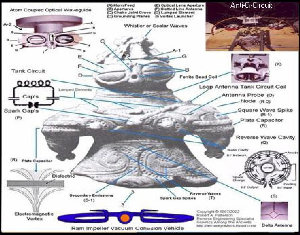
From this statue he developed his electronic zero point energy-pumping device and called it the ‘Dampened-wave Oscillatory Gravitic Unit’ (DOGU). It uses much of Tesla’s technology to extract free energy from space, according to the designer. Basically his device is rather straightforward and self-energises using antenna technologies to scavenge the resonant electromagnetic frequencies that exist in free space.
If Patterson’s DOGU invention is not already more than orthodox science can cope with, the idea that this planet could have been the home of cultures dating back to at least 8.000 BCE with access to the same space age technology we are just discovering, is mind boggling. However as we will abundantly prove in this book, these highly civilised cultures predating our current civilisation did indeed exist, and their scientific prowess has been transmitted to our current era by means of artefacts whose scientific significance completely evaded the archaeologists who unearthed them, and who could only wonder at the beauty of the art form itself. In chapter 1 ‘Earth Changes’ we mentioned that Edgar Cayce had predicted that the science of the sunken continent of Atlantis would resurface and the Dogu artefacts from antiquity can be regarded as evidence to corroborate Cayce’s predictions. (7)
Hutchison Effect
The Hutchison effect is a collection of phenomena that were discovered by the flamboyant John Hutchison in 1979. John Hutchison lives in Vancouver Canada in an apartment that he has completely stuffed with electronic equipment.
Hutchison has been experimenting in his apartment with scalar waves using Tesla coils and a Van de Graaff generator. Using radio wave interference of low energy input but at high voltages of hundreds of kilo Volts, he discovered amazing effects ranging from:
- levitation of heavy metals
- fusion of dissimilar materials
- anomalous heating of metals without burning adjacent material
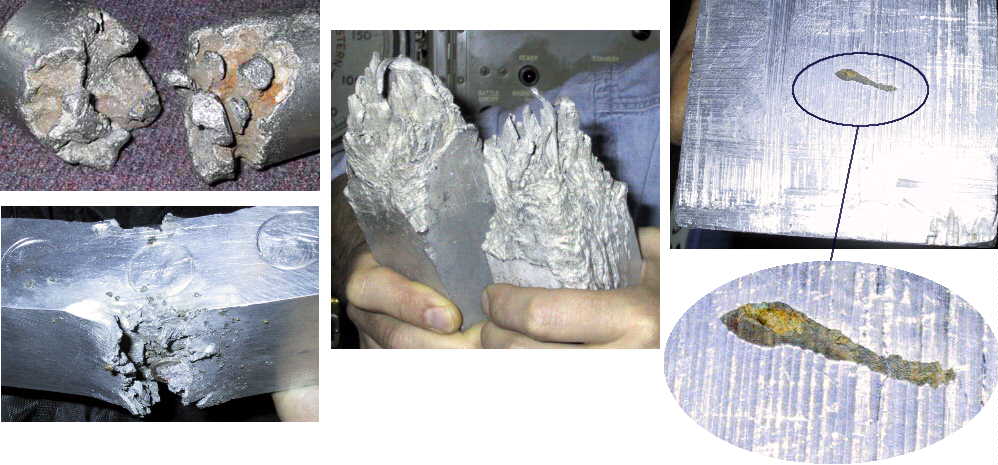
- fracturing metals in a strange way.
All of these effects have been documented on video and he has been demonstrating his discoveries to many qualified scientists and famous people who are now supporting him financially. The Hutchinson effect is demonstrated in movies on the Internet. In his movies we see objects floating in space and metals vibrating as if they are puddings.
He even levitates a heavy canon ball. He is also able to demonstrate the fusion of dissimilar materials such as wood and metal. The wood simply submerges into the metal and when the Hutchinson device is switched off, the wood remains as if it had been perfectly glued into the metal! In the same way he has melted coins into aluminium bars.
His experiments defy all common laws of nature! His anomalous waves having anti-gravity abilities seem to alter space-time itself.
He is able to melt metals without any burn marks or obvious heat radiation. Materials such as wood held in the same place where the metal is melted were not burned! This simply defies the laws of thermodynamics where at least some heat radiation should be apparent. Somehow his device seems to dissociate the normal organization of the atoms in a material. It is as if the Van der Waals forces that bind the atoms in the material are shut off and the atoms are free to be moulded into a new configuration.
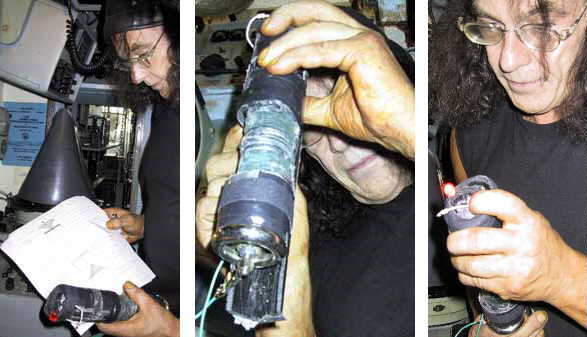
John Hutchinson has also developed a self-sustaining battery that recharges itself from zero point energy, so he claims! The battery generates 18V at 250mA! He says he got help from Tom Bearden with this one!(8)
Disclosure Project
Steven Greer has made a career out of disclosing the truth about free energy in his Disclosure Project. He is pressing politicians in the United States to come forward with the truth. According to Greer, the nuclear arms race and the Cold War with Russia has created a political climate in the United States in which top-secret projects were launched to develop advanced military technologies. These classified projects were executed under the strictest of secrecy and only on a need-to-know basis few were informed about these programmes. Gradually things have become so complex and out of control while illegally consuming billions of US Government budget dollars, that congressman and even the President himself have lost total authority over these projects.
Greer claims to have found several hundred whistle-blowers in the military, scientific and corporate community who can deliver documents, physical proof and testimonies of the deliberate suppression of advanced technological information. The military and intelligence are preventing public access to technologies that can definitely replace conventional oil, coal and nuclear energy sources. These technologies have been developed inside the United States for military applications, but when peacefully applied they can shape a totally non-polluting civilization and save our planet Earth.(9)
We could make an end to all poverty in the world by tapping into the free zero point energy from the vacuum. It could be locally used by the developing countries since the infrastructure of an energy grid would not be required. With the abundance of local energy it would be possible to create fresh water from seawater for irrigation in areas that are now suffering from draught.
Recapitulation
Empty space is not empty at all! The vacuum is actually a plenum. It contains an abundant amount of energy, the zero point energy. There is a cosmic dance of energy back and forth between the physical realm and the zero point field, a constant creation and destruction of matter from the void. The continuous flow of energy in and out of the material world resembles what Eastern Hindu cosmology described as the cosmic dance of Shiva.
Could it be that what scientists are observing as the zero point energy is in fact our own collective consciousness and that we are creating the physical world from this energy? If consciousness is indeed the first cause of physical reality and not the effect, at least we have identified a candidate for the required spiritual energy!
In the next chapter we will see how an ancient science that has been secretly preserved throughout history is now being reconstructed by modern science. This ancient knowledge is called sacred geometry and for some reason it was very important to be preserved for future generations. In antiquity it was taught in the mystery schools of the Egyptians and the Greeks. On penalty of death, initiates had to keep this knowledge secret throughout history. In the West this knowledge was preserved in Gnostic circles and secret societies of Freemasonry.
The science of sacred geometry claims that everything in our universe has an underlying invisible geometric structure following a fundamental principle. Contemporary scientists now use sacred geometry to explain how physical reality is constructed from the omni present and all-pervasive background energy of the physical vacuum.
Read the full version of this excellent book here: http://www.soulsofdistortion.nl/SODA_chapter4.html
Visit this awesome website here: http://www.soulsofdistortion.nl/

Liked this article? Dive deeper into personal growth and wellness! Check out CrystalWind.ca for spiritual wisdom or explore AromaWorx.ca for natural well-being tips. Spread the positivity—share this with friends on their happiness journey!
Let’s Chat! Drop Your Thoughts Below! 
Keep CrystalWind.ca free—your gift matters now!
Help us spread light today. Thank you, supporters!



Latest Articles



Shatter Illusions – Gain Clarity Now!
Instant Access On:



Imagine a world of inspiration and healing, free for all—made possible by YOU!
Donate Now—Ignite the Magic at CrystalWind.ca!


Epilepsy - Finding A Cure
Your donation can make a difference!
Help us find a cure – donate now!
Unlock Your Light: Join Lightworkers Worldwide on CrystalWind.ca!
Call For Writers

Follow Us!

Featured This Month
Page:
Mabon in Modern Times: Fresh Takes on the Au…
The Mabon season begins somewhere around the 21st-22nd of September and cont... Read more
Peridot: The Healer's Stone

Peridot has been used as a Power Stone for centuries. Peridot fosters emotio... Read more
The Vine: September 2nd - September 29th
The Autumnal Equinox ( Alban Elfed ) Celtic Symbol : The White Swan Read more
Mabon Magic: Ideas For Fall Decoration And R…

Welcome (almost!) to Fall! We’re turning the Great Wheel once again, toward ... Read more





Sun in Virgo

An Overview of Sun Sign Characteristics for Virgo The ruler of Virgo is Mer... Read more
Crystals for Virgo

During harvest time, when the seasons begin to transition from summer to fall,... Read more
Virgo Mythology

The Virgo Myth In all of constellation mythology, few legends are as misund... Read more

Watermelon Tourmaline
Synonym: Rainbow Tourmaline The watermelon tourmaline is a rare variety t... Read more