You are here: Home  Paranormal Divination Automatic Writing What's Actually Happening in the Brain During Automatic Writing
Paranormal Divination Automatic Writing What's Actually Happening in the Brain During Automatic WritingWhat's Actually Happening in the Brain During Automatic Writing
- Details
- Written by Nathaniel Cross
- Views: 20184
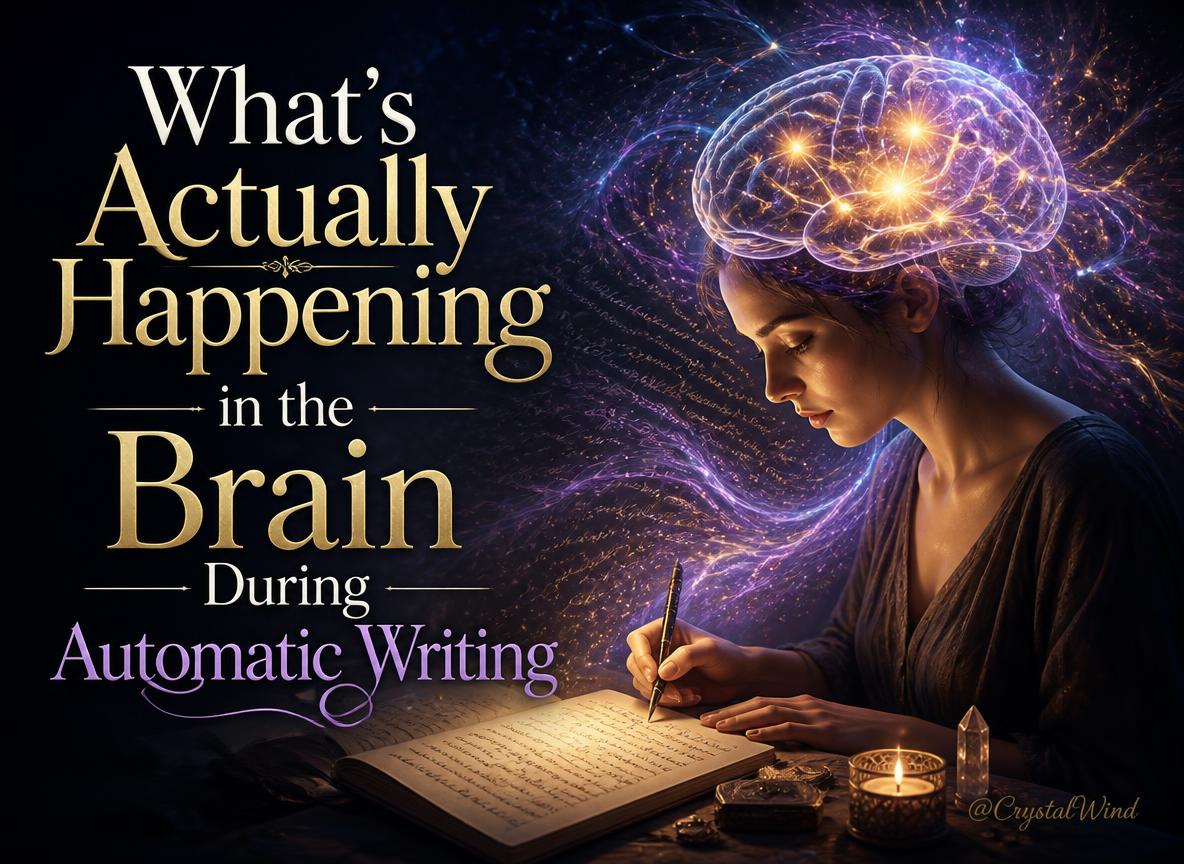
“Discover why the hand moves first” ~Crystal Wind
Automatic writing sits in an awkward gap between spirit contact and laboratory psychology, and that gap is exactly why the sensation keeps being argued past rather than examined. This piece stays with the felt experience itself: a hand that writes ahead of the narrating mind. The research on agency and the ideomotor effect does not settle what the pages mean. It does explain why the strangeness is real enough to study.
Read Time: 5 min | Exclusive Publication | Crystal Wind News Service |
Anyone who has genuinely experienced automatic writing describes the same core sensation: words arriving on the page faster than conscious thought seems to be producing them, in handwriting that sometimes looks subtly different from their own, with a distinct feeling that the hand is being moved rather than moving itself. Most explanations for this split into two unhelpful extremes, either a literal external entity guiding the pen, or a dismissive “it’s just your imagination” that doesn’t actually explain the sensation at all. Neuroscience has spent more attention on this phenomenon than either extreme suggests, and its answer is stranger and more interesting than a simple debunking.
The Key Concept: The Sense of Agency
The relevant piece of cognitive science is something researchers call the sense of agency, the ordinarily automatic feeling that you are the author of your own actions. It’s easy to take for granted because it almost never misfires. When it does misfire, under very specific conditions, the result is a genuine and measurable gap between an action a person’s body is performing and their subjective sense of having chosen to perform it.
This isn’t speculative. It’s been studied directly through experiments on the “ideomotor effect,” first documented in the nineteenth century and confirmed repeatedly since with modern tools. The ideomotor effect describes small, involuntary muscle movements driven by a thought, expectation, or suggestion, occurring without the person consciously willing them and, crucially, without the person’s sense of agency registering the movement as self-generated. The same underlying mechanism drives the Ouija board’s planchette and dowsing rods drifting in a practitioner’s hands: real physical movement, genuinely unconscious in origin, genuinely not felt as chosen.
Why the Writing Itself Can Look and Sound Different
Automatic writing sessions frequently produce text with a different vocabulary, tone, or even handwriting style than the person’s ordinary writing, which is often cited as evidence of an external source. Cognitive research on implicit memory and the structure of the unconscious offers a more grounded explanation: the conscious, narrating mind is only one part of an enormously larger information-processing system, and material that never surfaces in ordinary deliberate thought, memories, associations, half-formed ideas, absorbed language patterns from things read or overheard, remains fully available to that larger system. Automatic writing, by disengaging the usual conscious editorial process, appears to let some of that submerged material through more directly than normal, unfiltered writing would.
This is consistent with why automatic writing often produces material that surprises the writer, sometimes profoundly. It doesn’t require an external source to explain the surprise. It only requires that most of what any given mind actually contains stays outside conscious awareness most of the time, which cognitive science has established beyond serious dispute.
The Historical Thread: From Spiritualism to Psychology
Automatic writing has an unusually direct line running from occult practice into mainstream psychology. Nineteenth-century Spiritualists popularized it as a method of contacting the dead, but it was quickly picked up by early psychologists, including Pierre Janet and later Carl Jung, as a genuine, if unusual, window into unconscious material. Jung’s own experiments with active imagination, a deliberately induced state for accessing unconscious content, drew directly on automatic writing’s core method: relax deliberate control, let the hand or the imagination move without conscious direction, and see what surfaces.
This history matters because it means the psychological study of automatic writing isn’t a modern skeptical takedown of an old practice. It’s closer to a century and a half of genuine, ongoing curiosity from serious researchers about what a very specific altered relationship to one’s own hand can reveal.
What This Explanation Does and Doesn’t Settle
None of this proves or disproves what practitioners believe is actually happening during a session, whether the content that emerges is understood as spirit communication, higher self, or simply unconscious material finding an exit. What the ideomotor effect and sense-of-agency research does establish is that the physical sensation, a real, felt gap between the hand’s motion and any conscious decision to move it, is not itself evidence of an external source. It’s a documented, replicable feature of how the human nervous system can behave under exactly the conditions automatic writing sets up: relaxed attention, suspended judgment, and a pen resting lightly enough to respond to signals the conscious mind never registers sending.
For practitioners, understanding the mechanism doesn’t have to diminish the practice. If anything, knowing that the felt strangeness of automatic writing reflects something neuroscience takes seriously, rather than something to be embarrassed about or forced into an all-or-nothing paranormal claim, tends to make the practice easier to approach with genuine curiosity instead of needing to resolve the metaphysical question before picking up the pen at all.
Related Reading: An Introduction to Automatic Writing | Automatic Writing - A Form of Mediumship
Author
Crystal Wind News Service Editorial synthesis on automatic writing, the sense of agency, and the ideomotor effect for readers who want the sensation taken seriously without forcing an all-or-nothing claim.
Disclaimer: The information in this article is presented for educational and informational purposes only. Views expressed are those of the contributing author and do not necessarily reflect the views of CrystalWind.ca, which makes no claims regarding the accuracy of any content herein.
Explore More
Primary: #AutomaticWriting web #IdeomotorEffect web #SenseOfAgency web
Related: #Mediumship web
Primary: #AutomaticWriting web #IdeomotorEffect web #SenseOfAgency web
Related: #Mediumship web
© 2026 CrystalWind.ca | All Rights Reserved | Awakening Souls Since 2008
Support: Ko-Fi | PayPal
#CrystalWind #SpiritualJourney #Awakening

Enjoyed this article? Continue your journey with AromaWorx – wellness & aromatherapy , and support us at Support Crystal Wind™ .
Share your thoughts below! 
Recommended Tools & Resources
As an Amazon Associate we earn from qualifying purchases.
Keep CrystalWind.ca free—your gift matters now!
Help us spread light today. Thank you, supporters!

Support CrystalWind
Free spiritual inspiration since 2008
Help keep CrystalWind free and growing with a small contribution.
Buy us a coffee
Donate with PayPal


Latest Articles


✨ Digital Treasures ✨
The Crystal Wind Oracle
58-card deck • Lisa Iris art • ⭐⭐⭐⭐⭐
58-card deck • Lisa Iris art • ⭐⭐⭐⭐⭐
Crystal Lover's Handbook
67 crystals A–Z • chakras • healing uses
67 crystals A–Z • chakras • healing uses
Alchemy of Consciousness
Shift your reality from the inside out
Shift your reality from the inside out
Messages from the Archangels
Channeled guidance for your path
Channeled guidance for your path
Starseed Field Guide
Your mission • your origins • your tribe
Your mission • your origins • your tribe
Crystal & Mineral Wallchart
50+ stones • quick-reference • printable
50+ stones • quick-reference • printable
Complete Zodiac Collection
12 Lisa Iris prints • frame it • gift it
12 Lisa Iris prints • frame it • gift it
Zazzle Shop
Prints • posters • puzzles • gifts
Prints • posters • puzzles • gifts
Support CrystalWind.ca
Keep the light on • you have our gratitude
Keep the light on • you have our gratitude
✦ CRYSTAL WIND™ NETWORK ✦
- ✦ AscensionPulse.com — Ascension News
- ✦ LisaIris.com — Visionary Art
- ✦ ReikiWorks.ca — Energy Healing
- ✦ AromaWorX.ca — Aromatherapy
- ✦ Universal.net — Connecting the World
- ✦ NoBody.com — Be a Nobody

The Physical Card Deck
Dive into the Mystical World of the Crystal Wind Oracle Deck! Get All the Enchanting Details Now!
Grab Your Deck Now!NEW Expanded Boxed Edition!
Now with 58 Cards for Richer Wisdom!
The Mobile App
Shatter Illusions - Gain Clarity Now!
Instant Access On:
New! 53-Card Deck for Deeper Wisdom
See What Users Are Raving About!



Quake Watch
Thank You for Visiting CrystalWind!
We’re honored to be part of your journey.
Let’s grow together!
If this space has been meaningful, support it here.
Featured This Month
Page:
Virgo's Featured Stone - Sugilite
“Discover how sugilite builds lasting confidence” ~Crystal Wind In the realm ... Read more
Virgo Mythology
“Discover why Virgo embodies pure self-sufficiency” ~Crystal Wind The ancient... Read more

Sweet Violet

“Discover how violets awaken faithful heart powers” ~Crystal Wind These quiet... Read more
Sun in Virgo

“Discover how order becomes living grace” ~Crystal Wind This long-form Virgo ... Read more
Peridot: The Healer's Stone
Peridot has been used as a Power Stone for centuries. Peridot fosters emotio... Read more
Harvest Moon

“Discover how these totems foster balance” ~Crystal Wind Standing at the thre... Read more
Crystals for Virgo

As the warmth of summer begins to soften into the crispness of autumn, the Sun... Read more
Mabon in Modern Times: Fresh Takes on the Au…

The Mabon season begins somewhere around the 21st-22nd of September and cont... Read more
The Vine: September 2nd - September 29th
“Discover how swan grace steadies restless hearts” ~Crystal Wind As the wheel... Read more


Birth Totem - Bear

“Discover why Bear totem brings deep wisdom” ~Crystal Wind Read Time: 6 min |... Read more
Mabon Magic: Ideas For Fall Decoration And R…
Welcome to the season of Fall! As we turn the Great Wheel toward autumn in t... Read more
Watermelon Tourmaline
“Discover how rare crystals heal the heart” ~Crystal Wind This rare variety o... Read more