
What to Learn and Practice Before TSHTF
- Details
- Written by Dave Pollard
Because we cannot hope to predict how, when, how fast, or in what stages, civilization’s collapse is going to proceed, it’s pretty much impossible to “prepare” for it. In any case, collapse will continue to look very different from place to place — in the suburbs vs the inner city, in rich countries vs poor ones etc. And if some systems are just going to fall apart at some point, it’s awfully difficult to learn how to replace them when they’re still hanging in there (eg health care and education systems, and a lot of infrastructure and services).
So what is the concerned collapsnik supposed to do in the meantime?
Merlyn, in TH White’s The Once and Future King, says “The best thing for being sad is to learn something new.” But who has the time, or enthusiasm, to learn some challenging new survival skill, when the realization it will soon be needed just fills you with despair?
I’ve often found that the best way to get something into someone’s busy agenda is to make it easy, or make it fun. So what are some things that would be fun and easy to learn, and would also probably be useful as collapse deepens? Here are a few thoughts:
- The lessons of history (especially the history of collapse) — learn how the collapse of previous civilizations played out, and how their citizens dealt with collapse.
- Conversational skills (Dialogue, listening, articulation, interviewing, getting and focusing attention etc) — In a polarized world, where trust has been largely lost and people are desperate and distracted, we’re going to need to relearn the art of conversation, as a prerequisite to learning how to live together in new, radically relocalized communities.
- How to design, make, alter, and repair your own clothes — During the Great Depression, this was an important means by which people reduced their dependence on faltering systems and increased their resilience.
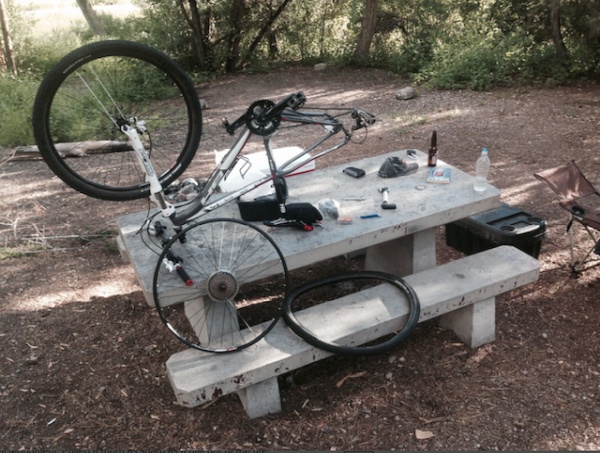
- How to repair your bicycle — Similarly, learning to do this for yourself will ensure that, even when cheap energy runs out, you’ll be able to get around safely, reliably and comfortably.
- Facilitation skills (helping groups function better together: consensus, “helping imagine”, conflict resolution, process management, self-organizing etc) — This is perhaps the most important ‘soft’ skill we can all learn. Here’s a tool I was involved in developing that can get you started.
- Wellness self-management — The firehose of information, and misinformation, on health matters is making it harder for us to take charge of our own health and wellness, but investing in learning how to diagnose your own symptoms, and doing some obvious interventions (eg improving your diet, exercising), can at least make you a useful partner with health professionals in managing your health.
- Furniture crafting — Lots of local community college courses are available on how to do this, that will keep stuff out of landfills and may also provide you with a new outlet for your creativity.
- Mentoring skills (guiding someone else’s learning: demonstration, research, questioning, being a useful sounding board etc) — The rigidity of formal education is gradually and sensibly being replaced by self-directed learning and education, making mentors (selected by, not imposed on, the student) more important than teachers. Learning mentoring skills will make you a better parent and community member as well. And showing people is often far more effective and enjoyable than telling them what to do.
- Improvisational skills — Whether in an amateur theatre group or a musical band, the art of improv can not only improve your artistic skills, it can increase your personal resilience, your listening skills, your capacity to adapt to new situations, and your compassion for others.
- About the place where you live (learning about the local ecology, orienteering, wildcrafting etc) — This is not about survival, but rather about understanding the interrelationships in the place you call home, and the resources that place has to offer, which may soon come to replace a lot of ‘imported’ foods and other resources. It can also improve your attention skills, your appreciation of nature and of where you live, and your sense of personal security.
Or you could self-assess your thinking skills (eg creative vs inductive vs deductive, sensemaking, cognitive biases, comfort with uncertainty and dissonance) and/or your relational skills (eg openness to new and diverse ideas, capacity to be vulnerable, and overcoming defensiveness), and practice getting better at them.
It’s not enough to learn these skills once, or in the abstract. Useful learning and skill-building requires practicing. Even better if you can find a group of colleagues (or students) who share your enthusiasm, with whom you can practice together. You may not need 10,000 hours, but the more you practice, the deeper your skill and the more value it will be to you and others when TSHTF. And having others on the same learning track can keep you at it when you’re tempted to give up.
If you’re initially interested but you lose that interest, step back and figure out why you’ve stalled. My experience has been that finding a way to make things easier or more fun is an effective means of keeping your field of study enjoyable and manageable when other demands on your time and energy intervene.
Thanks to Alberta Pedroja for prompting the writing of this article.
image by fellow Canadian blogger Alan Levine on flickr, CC-BY-2.0
Credit

This work is licensed under a
Creative Commons License.
Source Here
Dave Pollard's chronicle of civilization's collapse, creative works and essays on our culture. A trail of crumbs, runes and exclamations along my path in search of a better way to live and make a living, and a better understanding of how the world really works.

Liked this article? Dive deeper into personal growth and wellness! Check out CrystalWind.ca for spiritual wisdom or explore AromaWorx.ca for natural well-being tips. Spread the positivity—share this with friends on their happiness journey!
Let’s Chat! Drop Your Thoughts Below! 
Keep CrystalWind.ca free—your gift matters now!
Help us spread light today. Thank you, supporters!

Related Articles - Journey



Latest Articles


Dive into the Mystical World of the Crystal Wind Oracle Deck!
Get All the Enchanting Details Now!
NEW Expanded Boxed Edition!
Now with 58 Cards for Richer Wisdom!

Shatter Illusions – Gain Clarity Now!
Instant Access On:



Imagine a world of inspiration and healing, free for all—made possible by YOU!
Donate Now—Ignite the Magic at CrystalWind.ca!


Epilepsy - Finding A Cure
Your donation can make a difference!
Help us find a cure – donate now!
Unlock Your Light: Join Lightworkers Worldwide on CrystalWind.ca!
Call For Writers

Follow Us!

Featured This Month
Page:
Watermelon Tourmaline

Synonym: Rainbow Tourmaline The watermelon tourmaline is a rare variety t... Read more
The Vine: September 2nd - September 29th

The Autumnal Equinox ( Alban Elfed ) Celtic Symbol : The White Swan Read more

Sun in Virgo

An Overview of Sun Sign Characteristics for Virgo Virgo is guided by Mercur... Read more
Mabon Magic: Ideas For Fall Decoration And R…

Welcome (almost!) to Fall! We’re turning the Great Wheel once again, toward ... Read more
Mabon in Modern Times: Fresh Takes on the Au…
The Mabon season begins somewhere around the 21st-22nd of September and cont... Read more
Virgo Mythology

The Virgo Myth In all of constellation mythology, few legends are as misund... Read more
Peridot: The Healer's Stone
Peridot has been used as a Power Stone for centuries. Peridot fosters emotio... Read more


Sweet Violet
Sweet Violet Faithfulness and modesty. “I will always be true to you.” Helps... Read more


Crystals for Virgo

As the warmth of summer begins to soften into the crispness of autumn, the Sun... Read more