You are here: Home  Mystica Legends, Fables and Lore Lost Treasure and Gold The Dutchman's Lost Gold Mine
Mystica Legends, Fables and Lore Lost Treasure and Gold The Dutchman's Lost Gold MineThe Dutchman's Lost Gold Mine
- Details
- Written by AndEl
Lee Paul
One of the strangest, most enigmatic, of all stories to come out of the Arizona desert is that of the Dutchman’s Lost Mine. Some claim it is a myth, compounded and exaggerated by the successive imaginations of many people until it defies belief. Others say that it does exist, cleverly hidden somewhere among the forbidding peaks of the Superstition Mountains. Whatever the truth, it is a story which has weathered time. No one knows exactly when the old mine first came into existence, or even if it is one mine or several, but everyone knows when it disappeared. The Dutchman buried it to keep his secret, and then he died, leaving only mysterious clues for others to follow. To this day, it is the greatest living legend in the American Southwest.
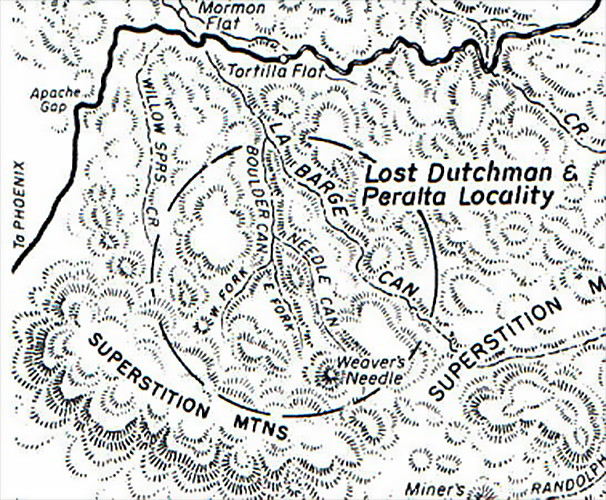
All that is truly known about the Dutchman’s Lost Mine is that it is located somewhere in a dry, twisted tangle of thirsty canyon throats in the rugged Superstition Mountains east of Phoenix. There are few clues to point the way, and in a mountain range which covers an area of roughly 160,000 acres of desolate, rugged terrain, the search for the elusive gold has driven men mad. Since the mountains are in the Sonoran Desert, desert vegetation is all that manages to grow, except for an occasional few sparse stands of ponderosa pine hanging onto the highest slopes. The elevation along the western boundary is a mere 2,000 feet, but it quickly climbs to over 6,000 feet in the eastern uplands, creating pockets of freezing cold at night and canyons full of dry, burning air during the day. With temperatures often exceeding 125 degrees in the shade, creek beds and streams quickly dry up. There are few roads, no water, and no shelter from the suffocating heat. The only landmarks are the mountains themselves, and they are rocky with jagged ridges, steep cliffs, and deep valleys.. With poisonous Gila monsters, scorpions, and deadly rattlesnakes at every turn, it is easy to see how this primitive wilderness and haunting loneliness came to be known as "Hell’s Backyard."
The story of gold in the Superstitions dates back centuries. Francisco Vasquez de Coronado challenged the forbidden peaks when he came north from Mexico in 1540 seeking the legendary Seven Golden Cities of Cibola. Several members of his band died searching for gold in the mountains, and like victims right up to recent years, their bodies were found headless by their companions. Although Coronado hurried onward to discover the Grand Canyon, the story of legendary hidden gold in the canyons persisted.
Different scholars today tell different stories about the origin of the fabled lost mine, but they all admit that the Apaches knew it first. The Indians had a secret gold cave hidden in the mountains, which they guarded well. When Jesuit priest Eusebio Francisco Kino explored the land, establishing missions during the first decade of 1700, he heard fabulous stories about this Apache gold…stories which claimed the gold vein was so huge that gold could be shoveled out of the earth by the spade full. It was not long before he had expeditions searching for the fabled treasure. The Apaches, friendly at first, became increasingly suspicious and hostile. The mountains were the home of their Thunder God, and if angered, he rumbled ominous warnings from mountain to mountain across canyons to trembling desert, spitting jagged words at any who dared enter his domain. The Apaches began to prey on all trespassers.
It is not known if Father Kino’s golden adventure is the fabled Dutchman’s Lost Mine or not. In 1748, Spanish King Ferdinand VI gave 3,750 square miles of what is now Arizona to a Mexican cattle-baron, Don Miguel Peralta of Sonora, in what was known as a "church grant." The area contained several silver mines as well as a fabulous gold mine in Arizona. This appears to be the first recorded history of its existence. Over the next one hundred years, the Peralta heirs made only a few sporadic trips from their home in Mexico to the gold mine. They arrived with enough mules and peon laborers to accumulate a sizable amount of ore, enough to last many years. They had a great respect for the Apache war parties and dared not press their luck with too many visits to the mine. In those days, Apaches had unique, incredibly painful methods of torture for any enemy they captured, and to discourage all trespassers, they left haunting reminders for others to find, victims with eyes gouged out and scalps missing or staked over ant hills. Gradually, anyone in the Peralta family with direct knowledge on how to get to the mine died. All that remained were crude maps to the location.
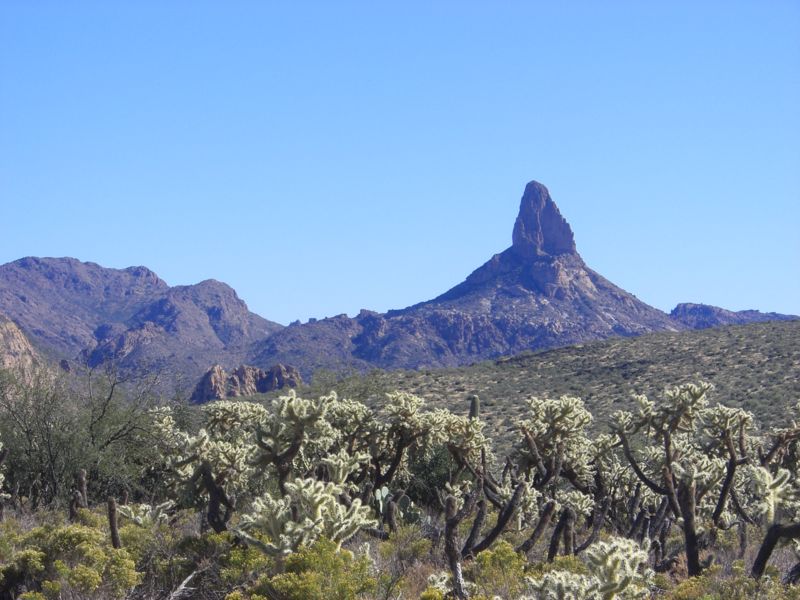
By 1846, the Peralta family’s silver mines in Chihuahua were on the verge of exhaustion, and the heirs were once again thinking of the gold in the hills to the north. Don Miguel, the current patron and descendant of the first Don Miguel, and his four sons, Enrico, Pedro, Manuel, and Ramon, decided to once again work their gold mine. With clues such as "the river drains a virgin wilderness in which gold anywhere will give clue to itself as erosion-borne placer particles in the riverbed…follow the river then until you find such placer gold, and trace it back to its source," the heirs began their fortune hunt. At what is the present site of Mormon Flat, three of the Peralta heirs, Pedro, Ramon, and Manuel, located a veritable paradise. It was a small, verdant valley in the middle of which LaBarge Creek, as yet unnamed, tumbled down in miniature cascade. Leaving Ramon and Manuel to build the necessary arrastres to smelter the ore, Pedro, the oldest, climbed the mountain from LaBarge into Boulder Creek and on up the tributary Needle Canyon. There, within a few miles north of a towering, hat-shaped peak he called La Sombrera, which now goes by Weaver’s Needle, he fell to prospecting for the source of the gold found in the river far below. When supplies ran low, Pedro went back down into Needle Canyon and drew a triangulation locator map, and he and his two brothers returned to Sonora. Pedro was the only one willing to return to the mine, and when he and the other members of his party were later massacred in his gold camp during the winter of 1847-48, his mysterious gold bonanza’s location died with him.
As tragic as this massacre was, it created a legend that has enticed treasure seekers ever since. Burros fleeing into ravines and washes with gold concentrate packed heavily in their saddles were not pursued by the Apaches. Even when caught for food, their captors threw aside the saddlebags, as Apaches of that time had no interest in gold. In the 1850’s, two prospectors came upon three dead burros with full packsaddles, netting them $37,000 from the United States mint in California. It is also this story of packsaddles stuffed with gold which has led some people to think it was the source of the Dutchman’s gold.
Things were somewhat peaceful between the Peraltas and the Apaches for sixteen years, in the sense that the Peralta heirs were very shy about working their mine. Still, their sporadic forays managed to taunt the Apaches. In 1864, the Apaches struck. In what turned out to be one of the bloodiest massacres in Arizona history, Enrico Peralta, Don Miguel’s grandson and heir, and his party of four hundred miners were ambushed and wiped out at a place now known as Massacre Ground on the northwest slope of the mountain. Only one man survived. This survivor eventually reached Mexico with a map to the Peralta’s "Sombrero Mine," but none of the remaining Peralta heirs ever dared venture another trip into Arizona to find it.
As news of Apache gold in the Superstitions spread like wildfire, fortune seekers came from all over to risk their lives for it. And risk it, they did. "Run for your life" had real meaning in those days. If you did outrun the Indians, then you did have your life, but that is about all you had to face the desert thirst. The Apaches were fierce adversaries, and they captured and killed everyone who dared trespass into their mountains unbidden. So fierce were the Apaches that the main trail through the range assumed a new name: the Apache Trail. It did not stop the gold hunters. Those that were not captured, tortured and killed by the Indians returned empty-handed, or died on the trail from the inhospitable elements. Without a guide or a map, the Apache mine remained lost.
Sometime in the ensuing years, the Apaches had a change of heart about the location of their secret mine because they offered to show Dr. Abraham Thorne a place where he could pick up gold. Thorne was an Army surgeon stationed at Fort McDowell, just north of Phoenix, and he had lived among the Apaches for many years and was on friendly terms with them. He had helped them through sickness and illness and with childbirth and broken-bone splints and things of that nature. After curing several Apaches of some kind of eye disease, they wanted to reward him and offered to take him to their gold. He was blindfolded for the twenty-mile trip deep into the mountains.
When the blindfold was removed, Thorne cautiously looked around him. He saw that he was in a canyon, and to the south, he noticed a large pinnacle of rock of unusual shape. He looked around for a mine entrance and saw none, but at the base of one of the canyon walls, he saw a pile of almost pure gold. He said it was apparent that the gold had already been partially refined, that the gold was not part of a natural deposit. The Apaches allowed him to take as much gold as he could carry. He was then blindfolded for the return trip and led out of the mountains. When he subsequently sold the gold for $6,000, making him instantly wealthy, he decided that one day he would try to find the mine on his own.
As his money ran low, Abraham Thorne and a group of his friends loaded up several mules with food and equipment and headed into the Superstitions. They had a rough idea in which direction the mine lay from the description of the rock formation Thorne had seen on his one and only guided trip, but none of them were really familiar with the surrounding territory. Incredibly, they managed to stumble upon the mine’s location by themselves. They eagerly filled their pokes and turned back toward Phoenix, but they never lived to tell of their discovery. The Apaches found them and killed everyone before they could escape with the gold.
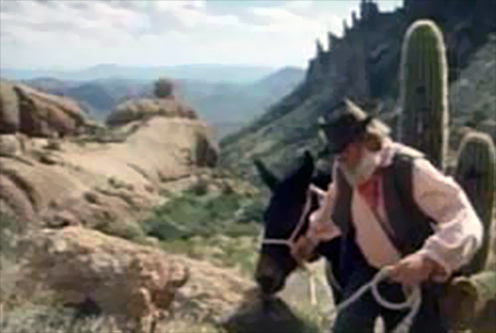
In 1871, two German adventurers, Jacob Waltz and Jacob Wisner, entered the story. Jacob Waltz has sometimes had his surname spelled Walz, Walzer, Walls, and Wolz by historians, as well as several other variants, and it is presumed it is because he came from a family of weavers in Germany, many of whom were uneducated. With family members barely able to read and write, the surname was always being misspelled. Although Jacob was well-educated, to this day, no one is quite sure which spelling is the correct one, as he apparently used different variants while crossing the United States.
The two Jacobs were very close. It is known that both men had lived in the same city in Germany, and this has led some historians to claim that they were related, that Wisner was the nephew of Waltz. It is a possibility, but there is no real way to prove it without extensive study. People did travel together back then in family groups for safety, and not that much is really known about Wisner.
Waltz, on the other hand, was born Jacob von Walzer at Wurtenburg, Germany in 1808. He was an educated man, a mining engineer graduated from Heidelburg University, and a 32nd degree Mason. When he arrived in America in 1839, he had in his possession the sum of $5,000, making him a wealthy man at the time. He settled first in St. Louis, Missouri. When the gold rush hit California in 1849, he headed west. In an 1850 census of Sacramento, there is a J. W. Walls enumerated, who could be Jacob Waltz. In the 1860 census of Los Angeles, there is a Jacob Waltz, who claims to be a miner. On 19 July 1861, at Los Angeles in the Court for the First District, he became naturalized as a citizen of the United States, although he would later claim that he was never a citizen and this is why he never recorded his claim in the Superstitions. He moved from Los Angeles to Wickenburg, Arizona, in 1862, and the 1864 Territorial Census of the Third District (Yavapai County) lists him as Jacob Walzer, a miner who had lived in the county for two years. In this same census is listed Jacob Wisner, a carpenter, living in the town of Florence. In the 1880 census at Phoenix, Waltz lists his occupation as farmer. He also appears on the Great Register of Maricopa County for 1876, 1882, and 1886 as a resident of Phoenix born in Germany.
By 1863, Waltz had staked his first claim in an area around Prescott, and in March of the following year, he signed a petition to Governor John N. Goodwin asking for protection from the Indians. This was in response to an attack on 2 March in which eight other men were killed. Also in 1864, he filed several more claims in the Prescott area, but there is no record that any of his claims ever did him much good. The mere fact that he filed claims in this area has fueled the speculation that his famous mine of legend was not really in the Superstitions at all, but in the mountains near Prescott.
It is known that when Waltz first moved to Arizona, he worked as a consultant in the Vulture Gold Mine owned by Henry Wickenburg in the town of Wickenburg. It is unknown when he met the Apache girl, Ken-tee, who also worked at the mine, but she soon became his mistress, although he was nearing sixty at the time. Suspected of high-grading ore from the mine (stealing choice pieces of ore), an inquiry was held. Their living quarters were searched, and although the gold did not turn up, Waltz and Ken-tee were dismissed from the Vulture anyway. The high-graded ore story, however, has led many to believe this was the true source of Jacob’s gold.
It was Ken-tee’s Apache relatives who were convinced that she had betrayed the site of their secret shrine. According to their ancient superstition, the gold had been placed there by the Thunder God of the Mountain for the Apaches to use only in time of desperate need. When Ken-tee led Waltz to the gold, and they returned to Phoenix with nearly $70,000 of the precious metal, the Apaches raided within seventy-two hours. With a war party that lasted two days and a night, the Apaches failed to get the Dutchman, although they did manage to wound him in the shoulder with an arrow. However, they did manage to seize Ken-tee. Neighbors rescued her, but not before the braves had cut out her tongue. She died within the hour.
Waltz, embittered and angry, retreated to Phoenix. From 1874 to 1877, he made only occasional trips back to the Apache shrine. As far as any watchers could determine, he had no interest in staking a legal claim to his mine. Except for intervals of heavy drinking and brawling, he lived a reclusive life. He built a saloon at Tortilla Flats, a hole-in-the-wall place in the middle of nowhere at the base of one of the hills. Today, a sign outside the saloon proclaims that he had a reputation as a "notorious liar, drunkard, and general miscreant who avoided gainful employment with singular dedication." Still, there were others who knew Jacob as kind, gentle, a teetotaler, and good friend.
From this point onward, there are many discrepancies in the Dutchman’s legend. For one thing, many historians began to refer to the story as the Lost Dutchman’s Mine, which is a complete misnomer because the Dutchman was never lost a day in his life. As a prospector, he knew every inch of where he was going, and as a miner, he knew gold. The gold coming from his mine is unlike that from any other mine in Arizona. It’s been compared to all those in existence, and experts agree that is it new, virgin gold. This completely rules out any theories that his gold was high-graded from elsewhere. It also confirms that his gold was not dug from the earth and smeltered, as was the Peralta story.
There is also a big discrepancy in how the story continues from this point. The popular version has Waltz and Wisner deciding to seek their fortunes in the Sonora area of Northern Mexico. For some strange reason, possibly because of their thick, guttural accents, local folks thought they were prospectors from Holland and nicknamed them the "Dutchmen," but there is a logical reason for this. Two prospectors in the same area at the same time were named Jacobs and Ludi, and these two men were from Holland and called Dutchmen. However he came by it, "Dutchman" was to be a nickname Jacob Waltz would carry to his grave.
The two men told friends that they had rescued a man named Don Miguel Peralta from a brawl in the tiny Mexican town of Arispe, where Peralta had been on the receiving end of a knife. This Don Miguel turned out to be the son and heir of Enrico Peralta, and Enrico was the grandson of the Don Miguel who was the descendant of the original Don Miguel Peralto, who had been given the original mine by King Ferdinand VI. This third Don Miguel Peralta told the two Jacobs of the old family mine of his great-ancestor’s. He also told them of the devastating Apache attack.
According to stories later told independently by Waltz and Wisner, Don Miguel had fallen on hard times and desperately needed money to keep his ranch running. Since the Dutchmen were experienced prospectors and the Mexican peon laborers were not, Don Miguel wanted the Dutchmen to go to Arizona with him in return for a share in the mine’s profits. With the aid of the Peralta family map, the men finally found the mine. How they managed to escape the Apache war parties is not known. The three men picked up several mule loads of gold and headed south toward Tucson, where they sold the gold for $60,000 before heading back to Mexico. Don Miguel, frightened of an Apache attack the whole trip, never wanted to return to the mine. He sold the map and title to the mine to the Dutchmen for their share of the profits.
It is true that Waltz did get Wisner to help him work a gold deposit, only this was around 1877 and not 1871. They took only as much as they needed to live on for several weeks at a time, storing the rest in two caches some distance away for safety in case the Apaches attacked. In his later years, Waltz would describe the location of the mine as being in "such rough country that you could be right in the mine without seeing it." He further said it was a large round pit, "shaped like a funnel with the large end up." The ore was said to be "wonderfully rich, and easy to take out of the rock in a gold vein eighteen inches wide, disappearing into the rock."
The two Jacobs always worked the mine together, one standing guard with a rifle until the other came up with a sack of ore. Even with these precautions, after weeks of back-breaking labor, calamity still struck. In Waltz’s own words, "It was that infernal mule. You know how it is. Mules won’t leave horses, so we let the beast wander around without hobbles. The rogue mule wandered to the tree where we’d hung our sacks of flour, hams, and the like. Somehow the confounded critter managed to reach the flour sacks with his teeth. He wasn’t content with one sack, of course. He pulled them all down, and all the flour spilled out. He ate some of it and walked in the rest."
As Jacob Waltz returned to civilization to replenish the supplies, Jacob Wisner stayed at the mine. Waltz was gone five days. When he returned to camp, he found it destroyed without an animal in sight. Here again, legend and truth diverge. According to the legend, his best friend and partner, Jacob Wisner, was missing. On the ground lay a blood-stained shirt, still sporting Wisner’s Masonic pin, and Apache arrows. To the Apaches, who took every article of clothing they could use from their unfortunate victims, a Masonic pin would have represented connections with the evil spirits---a taboo to be avoided at all costs. The shirt was left behind.
Waltz raced to the mine hoping Wisner was still alive and in hiding, but he found the mine camp destroyed, too. All that was left was one frying pan, "and the Apaches had driven a pick through it." Jacob hurriedly grabbed some of the cached gold and fled back to Phoenix. He spent the rest of his life mourning Wisner’s death.
Unknown to Waltz, Wisner survived the Apache attack. He made his way to Walker’s ranch, where he met John D. Walker, who tried to nurse him to health to no avail. Wisner lived long enough to tell his story to Walker, and then he died, leaving corroboration for the story of the lost mine. He also dispelled any rumors that it was Waltz who had shot him, which some historians still claim to this day.
Except for the fact that the camp was raided by Apaches while Waltz was in town replenishing supplies, the tale could be just that…a tale. Waltz did return to find the camp destroyed by Apaches, but there is evidence to suggest that the truth was more gruesome than the legend reported. Waltz apparently returned with the supplies to find his partner "staked-out" - spread-eagled over the coals of his campfire, fried to a crisp. It was February 1879, and it so unnerved him that he returned to the village of Phoenix without grub, gold, or water, raving about the Apaches. This version of the story was recorded at the time. When Waltz calmed down three days later, he went back and buried Wisner, bringing back the other man’s personal belongings. Several years later, when people scoffed at him, Waltz would tell them to "go find Wisner’s grave. I buried him near the mine."
Writer Barney Barnard has also said that he knew the Walker family, four generations of them, and not one of them ever heard of the Wisner survival story. Further, for Wisner to crawl injured to the Walker ranch, he had to first crawl past Jim Bark’s ranch at the foot of the mountain, on past Chuck Whitlow’s ranch and stage station on Queen Creek, which is not far from the site of Florence Junction, and then on to Walker’s ranch, a distance of forty-five miles!
Whatever the true story is surrounding the death of Wisner, Jacob Waltz never returned to the Apache mine for gold. He made short three- to four-day trips back to the old campsite where, during the two years of his partnership with Wisner, they had cached away millions. He never revealed its location, and to hide his trail, he tied blankets to the backs of his animals, letting the blankets sweep away all tracks. He never filed a claim on it because, "I was not a citizen of the United States, nor had I declared my intentions of becoming one. So, for that reason I couldn’t locate and record the mine." Since he was, in fact, a legal citizen, having been naturalized in Los Angeles, California in 1861, one has to wonder why he made this statement. It tends to shed doubt on anything he ever said.
The sad truth is that the Dutchman and his mine remain mysteries. Jacob Waltz was in his fifties by the time he found his mine, and this has prompted many cynics to believe Waltz was an old fool. They claim that the mine probably never existed in the first place. They think he robbed and waylaid stagecoaches and strangers on the other side of the Superstitions for his spending money...concocting the mine story to explain his new-found wealth. Others insist Waltz found a cache hidden by the Spanish. No one really knows the truth. There is no way to adequately explain away the old-time story of a chimney of gold. It is a fact that no one ever saw Jacob with more than a few nuggets at a time. It is also known that those who tried to follow him into the Superstitions were either lost in the maze of canyons or later found dead with their heads cut off. Yet, whenever Jacob needed money, he would pack back in to the mysterious mountains for a few days and then return with a little sack full of gold nuggets.
In the summer of 1884, things took a slightly different twist. Two young soldiers apparently found the mine by chance, and their story fueled renewed interest in Jacob Waltz’s claim of a rich mine back in the hills. The soldiers, who had recently been discharged from the Army at Fort McDowell, had decided to stay in the West to seek their fortunes. They rode into the town of Pinal with their saddlebags brimming with gold. They told an astonished listener, Aaron Mason, manager of the Silver King Mine, that they got it from a "funnel-shaped mine in a canyon near a sharp pinnacle of rock," which they had seen in their scouting days with the Army. They claimed it was in God-forsaken country and that they had to go through a tunnel between the peaks on a foot trail before stumbling upon it. They further said that they could re-find it, that it was in a northerly direction from the sharp peak.
This news of re-finding the location sparked a lot of local interest. If it turned out to be the mysterious Dutchman’s mine, it would answer a lot of questions people had about the Dutchman’s integrity. To prove they could do it, the two soldiers went back for more gold. They never returned. When a search party found their stripped and mutilated bodies dumped on the trail, tongues again wagged. How was Waltz able to get in and out of the canyons unobserved? What peak were the two soldiers referencing? Aaron Mason later said that he believed the soldiers were talking about Weaver’s Needle, which in Spanish days had been known as Sombrero Peak.
There is an interesting footnote to this mysterious legend: the Apaches decided to hide their mine in 1882. They decided that the only way to protect their secret was to conceal it in such a manner that only the Apaches would ever be able to find it. Apache Jack was a boy of twelve when the tribe set about concealing the entrance. He reported many years later, when he was an old man, that in true Indian fashion, a band of thirty squaws and two youths labored for one full moon, throwing ore and hastily abandoned tools back into the shaft. They then covered everything with stout logs, which were in turn covered with the natural caliche cement that hardens into rock. Over all, they placed another covering of dirt and surface stones to match the surrounding area. Finally, rocks were shifted around to disguise everything. Soon afterward, Providence lent a hand. In 1887, an earthquake further rearranged the topography.
Whose funnel-shaped mine did the soldiers find, if Jacob Waltz’s mine and the Apaches’ mine are one and the same mine?
Apache Jack further said that the Apache left a marker. In a steep-climbing arroyo high upon a mountainside where no white prospector would normally think of looking for gold, was a bright yellow ribbon of it in a narrow vein of rose quartz. It lay under towering cliffs, which overhung the whole arroyo, within plain sight of nearby Weaver’s Needle, and thinking no white man would ever venture there, the Apaches did not conceal this place. Below was the secret marker, an eight-foot high boulder hoisted upon the skyline of a ridge which, because it formed an abrupt bend in the north-south trending Needle Canyon, formed also for a few hundreds yards the only south slope. This boulder had been chiseled to look like a rampant horse’s head with mouth open, one ear laid back and with the other ear standing straight up. However, it was only so recognized against the sky when viewed from down canyon a short ways to the north.
By the late 1880’s, Jacob Waltz was so advanced in age that protecting his mine from interlopers was hard for him to do. When he was eighty years old in 1890, he decided to hide the mine. He is said to have enlarged the shaft two-and-one-half feet all around and then left a ledge about six feet deep at the entrance of the mine. He then sawed timbers the right length to fit the ledge, hauled them to the mine, and worked all winter laying in "a solid crisscrossed pattern of those ironwood logs" up to a depth of about two feet from the top. He next filled the hole with dirt and then topped it with stones from the surrounding area. When he was finished, he bragged "you could drive a pack train over the entrance to the mine and never know it was there."
Several months after Waltz hid the mine, he contracted pneumonia. He owned a simple adobe house on a small farm at the edge of the Salt River, about a mile from the outskirts southeast of Phoenix, with a few chickens and meager comforts. Since he shunned city life and had no real need for possessions, his only real friends were a mulatto woman bread baker from Louisiana named Julia Thomas, to whom he sold his chicken eggs. That spring, torrential rains fell on the mountains, swelling the Salt and Verde Rivers. History records the great February 1891 flood, which bore down on Phoenix, as the most ruinous in the American Southwest.
Waltz survived the flood by climbing into a small mesquite tree and tying himself fast. He was marooned there for two days and two nights. Right here, the stories differ as to the Dutchman’s rescuers. One reports that a man named Johnny Griejalva and his son, Juan Jr., cut Waltz loose from the tree and took him to their home. Later, they took him to the home of Julia Thomas, who took in victims of the flood.
The most publicized account, however, claims that Herman and Reinhardt Petrasch, sons of Gottfried Petrasch, went to check on the Dutchman. Although the Salt River was flooding, the horse managed to slosh its way to Jacob’s farmhouse without too much trouble. Reiney claims to have found Jacob sitting atop his bed with a blanket over his legs and a lighted candle in his hand. Jacob said he had taken a chill while trying to round up his chickens to put them on the roof of the coop. At the height of the flood, he had managed to lash himself onto a tree with just his head and shoulder out of the water, where he had remained for two nights and a day in the icy water. Reiney later told Julia, who had opened her home to flood victims and where Reiney took the Dutchman, "He was shivering violently as I put him on the horse."
Julia tried to nurse Jacob back to health, only his tired, old body was too feeble to resist his illness. He spent the entire summer in his sick bed. He did make his friends understand that he wanted something from his old home, but the adobe brick construction had melted away in the flood. Searchers were finally able to locate five sacks of gold worth about $15,000, which they placed in a candle box under his sick bed. Before he died on 25 October 1891, he tried to tell Julia and another old prospector friend of his, Dick Holmes, just where the mine was. Paralyzed almost to the point of speechlessness by a stroke, all he could give was sketchy clues. He said, "…the northwest corner of the Superstition Mountains. The key is a stripped paloverde tree with one limb left on, a pointing arm. It points away from the rock, about halfway from between it and the rock, and 200 yards to the east. Take the trail in. I left a number of clues." Then, he died.
The Dutchman’s body was immediately readied for burial. Reinhardt Petrasch acted as undertaker. A rough box was made and lined with gunny-sacks, and a small, one-horse dray was used to carry the body to the cemetery. He lies buried beside baby George and Rachel Petrasch, along with an unknown stranger in Lot 19, Grave 4 of Porter’s addition to the City Cemetery.
Jacob Waltz died before he could give anyone a map that showed exactly where the mine lay, and the secret of the mine’s location went with him to the grave. Even though there are hundreds of maps in existence today, none of them came from Jacob Waltz. The story does not end here. Julia and the Petrasches, Rhinehart and his older brother Herman, were so anxious to get in the mountains that they went in mid-summer when the mountains were hotter than hell in a bucket. "It must have been a real ordeal for all of them" quoted papers at the time. They stayed almost five weeks, and they came out without any gold. The Arizona Republican in 1892 called it "A Queer Quest in Search of Gold." The story begins, "A Queer Quest, another ‘Lost Mine’ being hunted for by a woman. Mrs. E.W. Thomas, formerly of the Thomas Ice Cream Parlor, is now in the Superstition Mountains engaged in a work usually deemed strange for a woman’s sphere. She is prospecting for a lost mine...."
Julia Thomas invested everything she owned into this expedition, but she returned penniless. She never attempted to return to the Superstition Mountains again, and on 24 December 1917, in Phoenix, she died of Bright’s disease. She was buried Christmas Day in the Jewish Cemetery.
Rhinehart Petrasch was accused by his brother Herman of not paying attention at Jacob’s bedside and writing the clues down incorrectly. They never spoke again. Rhinehart continued to search sporadically over the next fifty years. When his eyesight began to fail, he realized he would never find the mine. He put a shotgun to his head in 1953. Herman died a few years later still searching for the lost mine.
In the years prior to his death, Jacob Waltz had left few clues to his bonanza. He was too sick from his illness to talk much, and he drifted in and out of coma from the day he was found until he died. He never left a will or told anyone exactly where his buried treasure was concealed. All his clues come from what he let slip over his years of working his claim. These clues include:
- He had to climb above his mine in order to see Weaver’s Needle to the south.
- He could see the Military Trail from his mine, but he could not see the mine from the Military Trail.
- In order to reach the mine, he had to crawl through a hole.
- Below his mine one mile is a rock with a natural face looking east.
- The setting sun would shine on his gold. It must be remembered that he said he hid his dug out gold a short distance from the mine, so does the setting sun shine on the mine entrance or his gold cache?
- Above his mine is a peak.
- He hid his mine with a juniper.
- His mine is located where no other miner would think to look for it.
- There is an unfinished stone house a short distance back from the western end.
- The terrain around the mine is very rough, and he could be right in the mine without seeing it.
- Close by is a juniper with one limb which points away from the Weaver’s Needle.
- The mine contained an eighteen-inch vein of rose quartz studded with gold nuggets and another vein of hematite quartz about one-third gold.
- The mine is near a hideout cave.
Since Jacob’s death, other clues of the mine’s existence have surfaced. In 1912, prospectors found gold ingots in the long grass at the spot where Enrico Peralta is supposed to have fought the Apaches in 1864. Nearby, there were the remains of camps and evidence that trees were cut down for pit props. Also in this same area is the sharp pinnacle of rock known as Weaver's Needle.
All the Dutchman’s clues seem to focus around Weaver’s Needle, and the search for the treasure usually begins there. The remnant of an ancient volcano, the rocky spire has become a beacon for adventurers and fortune seekers alike. Some treasure hunters even believe the ancient megalith marks the center of a magic circle that contains the untold wealth of a lost civilization. Geologists, however, disagree. They say the Superstitions are unlikely to contain gold in any measurable amount and, so far, they seem to be right: since the Dutchman staggered out of the mountains with his little sack of gold nuggets, no significant strike has been made there. Without some form of mineral evidence, miners would not search the Superstitions for gold, but dreamers certainly would.
It is this apparently lack of mineral evidence which has led some researchers to speculate that Jacob Waltz may have stumbled over the fabled Lost Aztec Treasure. This sounds completely cocky, except that it is a true legend, and one which Waltz could have uncovered. He did have raw, pure gold, and if he was not mining the Superstitions, where did he get his gold?
The Aztec story is a strange one. When Cortez captured the Aztec ruler Montezuma, the chief begged his people to kill him rather than let him be carried away as a prisoner. Guatomozin, chief counselor to Montezuma and leader of his warriors, took a bow and arrow from a nearby warrior and shot the arrow that killed Montezuma. All Montezuma’s family was captured by Cortez, with the exception of one daughter, Nezetin, who was in love with Guatomozin. When Cortez retreated, Nezetin married Quatomozin, and they became the rulers of what was left of the Aztec people.
When Cortez returned a few years later, Guatomozin was prepared. After the first invasion which resulted in Montezuma’s death, the Aztec treasure was stored in a place called "Montezuma’s Sunken Gardens." Spying the returning Spanish fleet at sea, a fast runner carried the news of the approaching armada to Guatomozin, who promptly had the treasure loaded into sacks. This fabulous treasure was entrusted to the High Priest, who supervised its transfer to secret hiding places in the mountains. According to the legend, the treasure-bearing slaves traveled in a northwesterly direction for many moons, and when they came to a mountain on the edge of a desert, the treasure was hidden, and the slaves put to death. The treasure was reportedly composed of silver, great quantities of rings and ornaments, and raw, pure gold. The Dutchman had raw, pure gold.
In 1931, an event took place which focused national attention on the Superstitions. This has helped preserve the Dutchman’s Lost Mine legend to this day. On a scorching summer day of that year, a retired Washington bureaucrat named Adolph Ruth told his friends that he was going to search for the Dutchman’s Lost Mine. He rode into the Superstitions carrying maps from the Peralta family, which he believed would pinpoint the location. A sixty-six year old greenhorn, Ruth had no idea of the danger he faced. He freely spoke of his maps, saying he felt they were genuine, and he seemed oblivious to the temptation they represented. The last time he was seen alive was when two cowboys left him in West Boulder Canyon.
Ruth was a precise man who kept a daily record of his movements and wrote detailed letters. His notebook stated, "It lies within an imaginary circle whose diameter is not more than five miles and whose center is marked by the Weaver’s Needle, about 2,500 feet high, among a confusion of lesser peaks and mountainous masses of basaltic rock. The first gorge on the south side from the west end of the range---they found a monumented trail which led them northward over a lofty ridge, thence downward past Sombrero Butte, into a long canyon running north, and finally to a tributary canyon very deep and rocky and densely wooded with a continuous thicket of scrub oak."
This very much described what Pedro Peralta had mapped before his death. According to Pedro’s brother Ramon, the only way to get to this location from the south was to "approach over the desert, go up the first deep canyon from the western end of the range, climb northward over the backbone of the mountains until coming within sight of a huge, sombrero-shaped peak, travel downward past the base of this La Sombrera into a long canyon running north, until at last you find on the east side, a tributary canyon which was very deep, pot-holed and densely wooded with scrub oak. Turn about and go back southward up this tributary canyon until reaching a point where the outlines of the hat-shaped peak to the south and the black-topped mountain to the west both match from the same place the outlines on the map."
Six months from the day he set out with his cowboy guides, an archeological party found Ruth’s skull. It had been neatly placed on top of a pile of rocks along the trail, and it looked like it had two bullet holes in one temple. His body was later discovered by a party of prospectors almost five miles from where the head had been found. In the pockets of his torn jacket was a scrap of paper with the words, "About 200 feet across from cave." Underneath was the Latin verse, "Veni. Vidi. Vici." ("I came. I saw. I conquered.") Still later, his camp was found, another three miles from where his body had been discovered. The map he had with him was never found, and his mysterious murder remains unsolved.
Did Ruth find the mine and was killed to protect its location? Many people think so. Doctor Ales Hrdlicka, anthropologist and pathologist for the National Museum, now known collectively as the Smithsonian Institution, examined the skull and stated that the two holes found in the temporal region were definitely made by bullets fired at such an angle that the victim could not have shot himself.
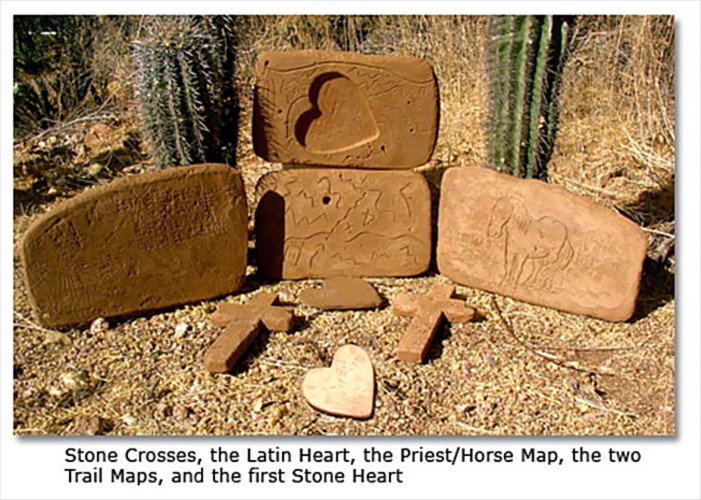
Ruth’s murder did not stop the fortune hunters. They kept coming in spite of the lack of evidence, the harshness of the terrain, and the history of tragedy. It’s an obsession seemingly shared by most gold hunters. In 1949, another discovery added more fuel to the quest. The infamous Peralta Stone Map No. 1 was found by an Oregon man and wife making a stop-over at a place near Florence Junction. The man was hunting arrowheads when he stumbled across a stone with inscription on it. He took the stone home with him, and on his next vacation to the same area a few years later, he uncovered three more stones which matched. These Peralta Stone Maps were finally released for public viewing in 1959, and they opened up a Pandora’s box. It wasn’t until 1966 that they were first suspected of being frauds, but during the interim, people flocked to the Superstitions in droves. In 1973, the stone maps were definitely proved to be frauds, based upon the Florence Quadrangle Map of 1900 conducted by the United States Department of the Interior and which was first published in 1902, but who was the trickster with the ingenuity to carve and bury the stones? It’s a mystery which has remained unsolved to this day.
Even though the geologists say the Superstitions are an unlikely location for gold, the legend persists. In the mid 1970’s, a retired science professor turned prospector, reported that he once received an offer of $13,000 for an unusual sample of gold-bearing rock he obtained in the Superstitions. He said he received $13,900 when he sold it; he gave some to the government for taxes; and he ended up with $9,000 for about twenty minutes work with a pick. With this rate of return, it would make a prospector out of anybody. Further, Jacob Waltz had a matchbox made from the high grade ore in his possession when he died. The ore was so rich that estimates are that it could be worth over $200 million dollars if found today. This does appear to prove the geologists wrong. It does not explain, however, why, if Jacob was so wealthy, did he live so frugally? Nobody knows. It is this hoped-for bonanza that keeps seekers coming.
In 1963, a group of Denver attorneys hired Glenn Magill, a private detective from Oklahoma City, to find the mine. Magill believed that with the right techniques, any mystery could be solved and that included the Dutchman’s Lost Mine. With the spirit of adventure in his veins, he took the case and caught the next plane to Phoenix. Magill thinks he found the mine in 1967, but not the vein of gold. Waltz stated that his gold came from a vein of quartz eighteen inches thick. Magill’s team uncovered a pit above a tunnel and other signs that fit Waltz’s clues, but that was all.
In the fall of 1976, Magill made his forty-ninth expedition into the Superstitions. He admitted to spending thousands of dollars, as well as sacrificing family relations and business gains during his search. He reported that the maps, the legend, and the witnesses all came together at one specific spot, and it indicated to him that the mine itself was composed of a vein of gold over eighteen miles long. But, has he found anything? No, and he has tried.
Many people believe the secret shrine of the Apaches and the Dutchman’s Lost Mine are one and the same, but there is no way to prove this one way or the other. Understandably, this theory is not popular with the Apaches, who still regard the Superstitions as sacred. For nearly two hundred years, treasure hunters have hunted for the fabled mine. A few of them may even have found it, but curiously, they all died before they could tell their tale. Is the mine cursed, as some claim? It is also worthy to note that those who claimed to have found it, did so by coming down an obscure trail from the north to the south, and not vice versa as most modern-day seekers do. They also all claimed they had to traverse a tunnel of some sort.
In 1984, a modern day treasure hunter claimed he had found the fabled mine, but he, too, never lived to tell anyone where it was located. Walter Gassler arrived in Phoenix in 1934 at an invitation to be the head pastry chef at the famous Arizona Biltmore Hotel. Since a good friend already had the job and since he refused to replace his good friend, Walt headed into the Superstitions. Thus began fifty years of searching for the fabled mine. Using clues handed down from Jacob’s deathbed description, Gassler spent most of his free time looking for the famous ore.
When Gassler’s health began to fail, he contacted two other prospectors. One was Bob Corbin, then Attorney General of Arizona, and the other was Tom Kollenborn. Tom grew up on a ranch in the Superstitions and had spent most of his spare time on horseback combing the hills for the elusive lode. Gassler wanted the two men to go with him and continue looking for the mine with his directions after he died. He gave them his notes as to where his camp was and where he believed the mine to be.
Several months later, Gassler called Kollenborn. Gassler was excited and claimed he had finally located the Dutchman’s mine. It was a Sunday evening, and he wanted Kollenborn to accompany him early the next morning, but Kollenborn could not break away on such short notice. Gassler refused to be mollified, saying he could not wait any longer. He told Kollenborn that he would go find it himself. He never came back. When Gassler’s wife dropped him off at the trailhead, he hiked alone into the Superstition Mountains and was never seen alive again.
Events then took a strange twist. One month after Walt’s death, Tom Kollenborn had a visitor. A man came over to his house claiming to be Roland Gassler, Walt Gassler’s son. He said that his father had found the Dutchman’s Lost Mine in the Superstitions, and he proceeded to produce a piece of gold which looked similar to the gold that had allegedly come from the mine. Ronald said it had come from Walt’s backpack. He proceeded to ask Kollenborn for Walt’s map and notes. Kollenborn did not have the map, but he gave the man Walt’s manuscript. Two months later, as Kollenborn finished one of his well-known slide lectures on the Superstitions, he was approached by yet another stranger who said he was Walt’s son, Roland.
Who was the first man who claimed to be Roland Gassler? It appears that he was an impostor who needed Walt’s map so he could search for himself. But, how did he get the gold ore sample? When Walt died, the sheriff’s report listed a backpack among Walt’s belongings, but the real Roland Gassler never received it. Furthermore, Don Shade, the man who found Walt’s body, remembered seeing the backpack. He also remembered seeing a stranger in the area. When he learned of Kollenborn’s description of the man that came to him and who showed him some gold, it matched the description Shade remembered of the stranger in the area.
Bob Corbin has said that he likes to believe that Walt found the mine because Walt spent so many years looking for it. Corbin also believes the Dutchman’s legend could be true. He has seen the ore that was under Jacob Waltz’s bed when he died. He has seen the assay reports on it at a jewelry store in Phoenix, which did exist at that time. It is rich gold ore.
Nevertheless, others still disagree. The dream is constantly being revised by stories like the one told by a prospector 1976, who claimed to have found the mine from an old map. He said he got "about $18,000 out of a pocket, which it proved to be, and it didn’t last very long." He claimed that The Lost Dutchman Mine had no relation to the Superstitions or to Weaver’s Needle. It was located in the Four Peaks country at about 4,800 feet in a big canyon. "People dream," he said. "They hear these stories and they’re greedy. They think God meant for them to find this gold and reserved it for them, so they go in there by the thousands. There was over 10,000 people from 1878 to 1891 in the Superstitions before the Dutchman died and left his legend."
Whether there is a hidden mine around Weaver’s Needle or not, it will undoubtedly remain the lodestone for new seekers. The Department of the Interior reclassified the Superstition Mountains as a federally-owned wilderness area in 1984. If the mine were found, all the gold would have to be surrendered to the government. This does not deter the treasure seekers. For them, the search for the lost mine is a fascinating mystery and a tradition that keeps alive one of the most enduring legends of the American Southwest.
When Jacob Waltz died, he left a trunk of ore and a list of clues to a hidden fortune in the Superstition Mountains. It has never been found. Legend or not, the Dutchman said he found gold there. If it happened once, it could happen again.
Source Here

Liked this article? Dive deeper into personal growth and wellness! Check out CrystalWind.ca for spiritual wisdom or explore AromaWorx.ca for natural well-being tips. Spread the positivity—share this with friends on their happiness journey!
Let’s Chat! Drop Your Thoughts Below! 
Keep CrystalWind.ca free—your gift matters now!
Help us spread light today. Thank you, supporters!



Latest Articles



Shatter Illusions – Gain Clarity Now!
Instant Access On:



Imagine a world of inspiration and healing, free for all—made possible by YOU!
Donate Now—Ignite the Magic at CrystalWind.ca!


Epilepsy - Finding A Cure
Your donation can make a difference!
Help us find a cure – donate now!
Unlock Your Light: Join Lightworkers Worldwide on CrystalWind.ca!
Call For Writers

Articles: Lost Treasure
Articles: Shambhala
Follow Us!

Featured This Month
Page:

Virgo Mythology

The Virgo Myth In all of constellation mythology, few legends are as misund... Read more
Watermelon Tourmaline

Synonym: Rainbow Tourmaline The watermelon tourmaline is a rare variety t... Read more
Mabon Magic: Ideas For Fall Decoration And R…

Welcome (almost!) to Fall! We’re turning the Great Wheel once again, toward ... Read more
Sun in Virgo

An Overview of Sun Sign Characteristics for Virgo Virgo is guided by Mercur... Read more
The Vine: September 2nd - September 29th

The Autumnal Equinox ( Alban Elfed ) Celtic Symbol : The White Swan Read more
Peridot: The Healer's Stone

Peridot has been used as a Power Stone for centuries. Peridot fosters emotio... Read more

Mabon in Modern Times: Fresh Takes on the Au…

The Mabon season begins somewhere around the 21st-22nd of September and cont... Read more
Crystals for Virgo

As the warmth of summer begins to soften into the crispness of autumn, the Sun... Read more


Sweet Violet

Sweet Violet Faithfulness and modesty. “I will always be true to you.” Helps... Read more