
How Shame Recodes Neglect as Someone Else's Tactic
- Details
- Written by M. L. Harrow
- Views: 321
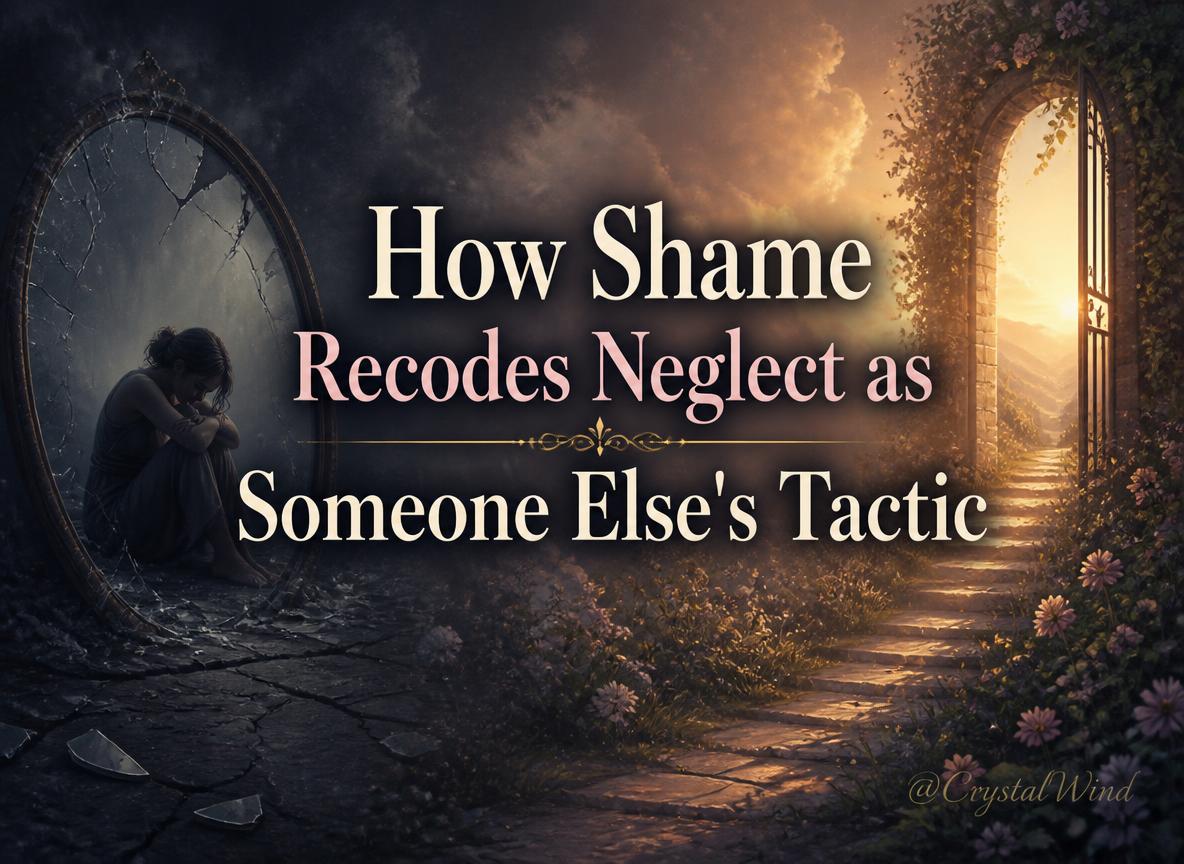
“Discover why a charge skips the facts” ~Crystal Wind
A familiar family snap often gets treated as the end of the matter. This article stays with the charge used to quiet a conscience that has already been pricked, while the missed calls and missing help stay exactly where they were.
Read Time: 7 min | Exclusive Publication | Crystal Wind News Service |
There is a familiar turn in family conversations. One person says, in some form: you do not come, you do not call, you do not help. The other person does not answer whether those things are true. They answer with a charge: you are guilt-tripping me.
That charge can also be something else: a way to silence a conscience that has already been pricked, without changing the behavior that pricked it. That pattern is what this note is about. It is documented in peer-reviewed psychology. The findings are summarized here so the argument stands on its own.
Guilt is not injected. It is recognized.
Guilt is an internal appraisal. It appears when a person already holds a standard — I should stay in contact with my father; I should help; I should not leave someone who cared for me standing alone — and then sees a gap between that standard and what they are doing. Another person can point at the gap. They cannot plant the standard.
That is why the popular line “you wouldn’t feel guilty if you weren’t” is half right. The feeling belongs to the hearer. The other half is just as important: the speaker can still stack the point badly, by attacking character (“you don’t care”) or collecting old debts (“after all I did for you”). Bad wording does not make the missing visits imaginary. The first job is still to separate the fact from the spin.
How people silence a guilty conscience
In 1998, Maria Miceli and Cristiano Castelfranchi published “How to Silence One’s Conscience: Cognitive Defenses Against the Feeling of Guilt” in the Journal for the Theory of Social Behaviour. It is a map of the moves people use to reduce guilt without repairing anything.
They group the defenses by what the person attacks in their own mind. First, responsibility: it wasn’t me; I wasn’t the main cause; I didn’t mean it; I couldn’t have done otherwise. Second, the evaluation of the act: I didn’t do anything wrong; it wasn’t that bad; the other person didn’t deserve better. Third, reparation: there is nothing to fix, or fixing it is someone else’s job.
Notice what is missing from that list: answering the complaint. The defenses change the story so the complaint no longer applies. “You’re just trying to make me feel guilty” belongs with those defenses. The neglect is recoded as the other person’s tactic. Once the speaker is the problem, the unanswered phone is no longer the problem.
"You’re just trying to make me feel guilty belongs with those defenses. The neglect is recoded as the other person’s tactic."
Pseudo self-forgiveness: feeling clean without getting clean
Lydia Woodyatt and Michael Wenzel gave that dodge an experimental name. In the Journal of Experimental Social Psychology (2013), they described pseudo self-forgiveness: minimizing the harm, denying wrongdoing, or putting down the injured person in order to get rid of guilt and shame without taking responsibility.
They ran a laboratory study and a field study that followed people for eleven days after a real interpersonal offense. Two results matter here. The more rejected people felt, the more they used the dodge. Hostile responses from the injured person made the dodge stronger over time. A respectful confrontation from a third party made it weaker.
That last point is practical. If the goal is to get the facts on the table, piling on “you don’t care” and “after everything I did” is the form most likely to produce the cover. Naming the missing behavior, without a character verdict, is the form least likely to. That is not a request to swallow the complaint. It is a note about which wording leaves the other person fewer exits.
Shame turns outward. Guilt turns toward repair.
June Tangney, Jeff Stuewig, and Debra Mashek reviewed this distinction in the Annual Review of Psychology in 2007, in “Moral Emotions and Moral Behavior.” The paper is widely cited because the split keeps replicating.
Guilt, in their account, is about a specific act: I did that; it cost someone; I should repair it. Shame is about the self: I am a bad son, a bad daughter, a bad person. Shame is harder to sit with. People try to get it off themselves. The common routes are withdrawal, anger, and blaming the person who made them feel exposed.
That is the psychology of the snap. “You’re guilt-tripping me” is often not a careful claim about persuasion technique. It is a shame reflex. The hearer has been pictured as the kind of person who neglects a parent, and they would rather prosecute the picture than inspect the week’s calendar. Tangney’s review is clear that shame-prone people are more likely to externalize blame and to express that blame as hostility. Guilt-prone people are more likely to confess, apologize, and try to undo the harm.
So if the reply is repair — a call, a visit, a concrete offer — the feeling that got them there was probably guilt, and the conversation did its job. If the reply is a counter-charge against the speaker, the feeling was probably shame, and the conversation has been moved off the facts on purpose.
What this does not replace
None of these papers invent a visit that did not happen. They describe a defense against the feeling of guilt. The phrase “you’re guilt-tripping me” is not evidence that the visits happened. It is not evidence that the help was given. Those things are still true or still false on their own.
The honest limit is this. The charge does not settle the calendar. It also does not erase the calendar. It moves the talk off the unanswered phone and onto the character of the person who named it.
The only question the charge cannot replace
If someone says you never come, you never call, you do not help, there are a small number of clean replies. Yes, that is true, and here is what I can do. No, that is not true, and here is the record. Yes, the contact is thin, and here is why, without a verdict on anyone’s character.
“You’re guilt-tripping me” is not one of those replies. In the language of Miceli and Castelfranchi, it is a defense against the feeling, not a correction of the facts. In the language of Woodyatt and Wenzel, it can be pseudo self-forgiveness: the self is cleared while the neglect is left standing. In the language of Tangney, it can be shame turned outward.
Send the charge back to the complaint. Did they come. Did they call. Did they help. That is the part that can be checked. The rest is weather.
References
- Miceli, M., & Castelfranchi, C. (1998). How to silence one’s conscience: Cognitive defenses against the feeling of guilt. Journal for the Theory of Social Behaviour, 28(3), 287–318.
- Tangney, J. P., Stuewig, J., & Mashek, D. J. (2007). Moral emotions and moral behavior. Annual Review of Psychology, 58, 345–372.
- Woodyatt, L., & Wenzel, M. (2013). The psychological immune response in the face of transgressions: Pseudo self-forgiveness and threat to belonging. Journal of Experimental Social Psychology, 49(6), 951–958.
Author
M. L. Harrow writes for Crystal Wind on the quieter mechanics of conscience, family speech, and the research that sits under everyday moral language.
Disclaimer: The information in this article is presented for educational and informational purposes only. Views expressed are those of the contributing author and do not necessarily reflect the views of CrystalWind.ca, which makes no claims regarding the accuracy of any content herein.
Explore More
Primary: #Guilt web #Shame web #Family Communication web
Related: #Psychological Defense web
Primary: #Guilt web #Shame web #Family Communication web
Related: #Psychological Defense web
© 2026 CrystalWind.ca | All Rights Reserved | Awakening Souls Since 2008
Support: Ko-Fi | PayPal
#CrystalWind #SpiritualJourney #Awakening

Enjoyed this article? Continue your journey with AromaWorx – wellness & aromatherapy , and support us at Support Crystal Wind™ .
Share your thoughts below! 






























































Support CrystalWind
Free spiritual inspiration since 2008
Help keep CrystalWind free and growing with a small contribution.
Buy us a coffee
Donate with PayPal


Latest Articles


✨ Digital Treasures ✨
The Crystal Wind Oracle
58-card deck • Lisa Iris art • ⭐⭐⭐⭐⭐
58-card deck • Lisa Iris art • ⭐⭐⭐⭐⭐
Crystal Lover's Handbook
67 crystals A–Z • chakras • healing uses
67 crystals A–Z • chakras • healing uses
Alchemy of Consciousness
Shift your reality from the inside out
Shift your reality from the inside out
Messages from the Archangels
Channeled guidance for your path
Channeled guidance for your path
Starseed Field Guide
Your mission • your origins • your tribe
Your mission • your origins • your tribe
Crystal & Mineral Wallchart
50+ stones • quick-reference • printable
50+ stones • quick-reference • printable
Complete Zodiac Collection
12 Lisa Iris prints • frame it • gift it
12 Lisa Iris prints • frame it • gift it
Zazzle Shop
Prints • posters • puzzles • gifts
Prints • posters • puzzles • gifts
Support CrystalWind.ca
Keep the light on • you have our gratitude
Keep the light on • you have our gratitude
✦ CRYSTAL WIND™ NETWORK ✦
- ✦ AscensionPulse.com — Ascension News
- ✦ LisaIris.com — Visionary Art
- ✦ ReikiWorks.ca — Energy Healing
- ✦ AromaWorX.ca — Aromatherapy
- ✦ Universal.net — Connecting the World
- ✦ NoBody.com — Be a Nobody

The Physical Card Deck

Dive into the Mystical World of the Crystal Wind Oracle Deck! Get All the Enchanting Details Now!
Grab Your Deck Now!NEW Expanded Boxed Edition!
Now with 58 Cards for Richer Wisdom!
The Mobile App

Shatter Illusions - Gain Clarity Now!
Instant Access On:
New! 53-Card Deck for Deeper Wisdom
See What Users Are Raving About!



Quake Watch
Thank You for Visiting CrystalWind!
We’re honored to be part of your journey.
Let’s grow together!
If this space has been meaningful, support it here.
Featured This Month
Page:


Mabon in Modern Times: Fresh Takes on the Au…

The Mabon season begins somewhere around the 21st-22nd of September and cont... Read more

Sun in Virgo

“Discover how order becomes living grace” ~Crystal Wind This long-form Virgo ... Read more
Peridot: The Healer's Stone
Peridot has been used as a Power Stone for centuries. Peridot fosters emotio... Read more
Watermelon Tourmaline
“Discover how rare crystals heal the heart” ~Crystal Wind This rare variety o... Read more
Virgo's Featured Stone - Sugilite
“Discover how sugilite builds lasting confidence” ~Crystal Wind In the realm ... Read more
Sweet Violet

“Discover how violets awaken faithful heart powers” ~Crystal Wind These quiet... Read more
Virgo Mythology

“Discover why Virgo embodies pure self-sufficiency” ~Crystal Wind The ancient... Read more
The Vine: September 2nd - September 29th

“Discover how swan grace steadies restless hearts” ~Crystal Wind As the wheel... Read more
Crystals for Virgo

As the warmth of summer begins to soften into the crispness of autumn, the Sun... Read more
Mabon Magic: Ideas For Fall Decoration And R…

Welcome to the season of Fall! As we turn the Great Wheel toward autumn in t... Read more
Birth Totem - Bear

“Discover why Bear totem brings deep wisdom” ~Crystal Wind Read Time: 6 min |... Read more
Harvest Moon

“Discover how these totems foster balance” ~Crystal Wind Standing at the thre... Read more