
The Steepest Meditation Shift Arrives Before Ten Minutes
- Details
- Written by Crystal Wind
- Views: 9358
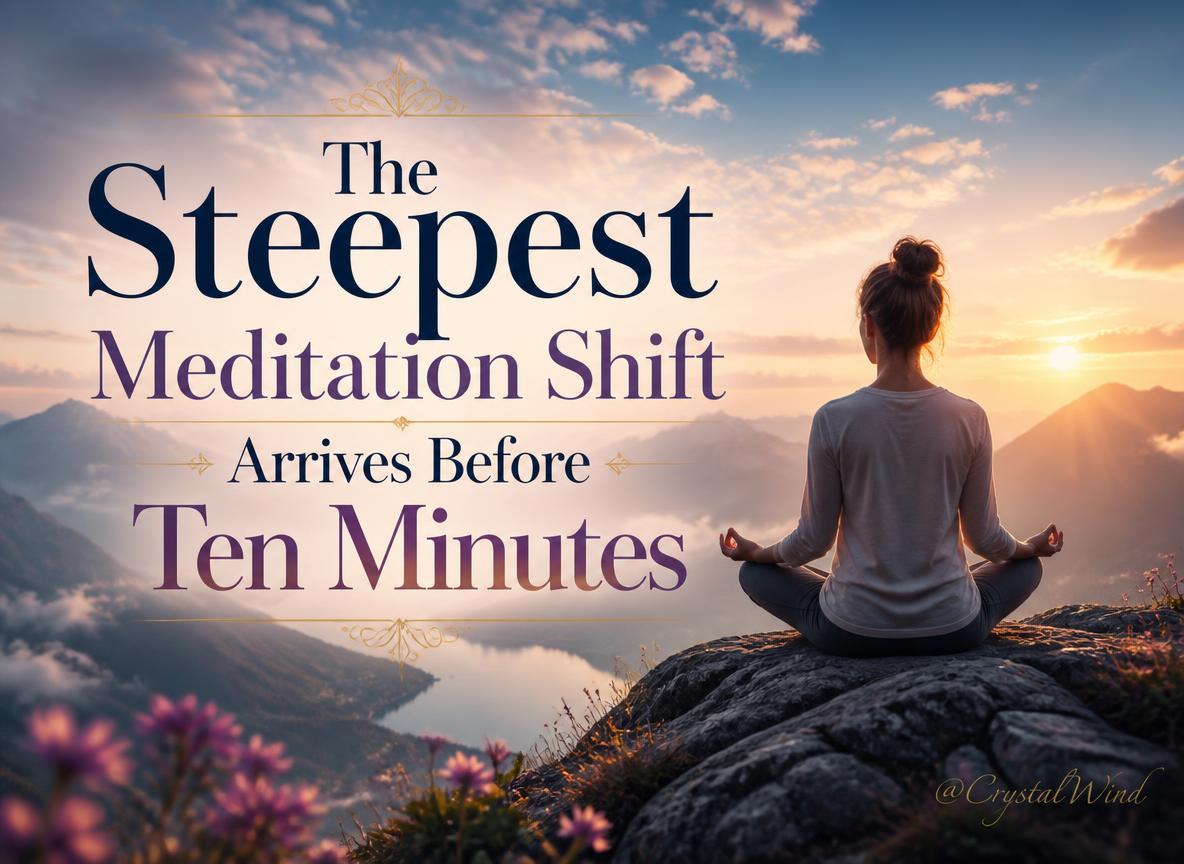
“Discover how short practice sparks relaxed alertness” ~Crystal Wind
This is not another lecture on sitting longer. A 2026 EEG study tracked breath-watching minute by minute and found the steepest change in brain rhythms well before the session most beginners abandon. The number is not a slogan. It is a map of when the curve actually turns.
Read Time: 6 min | Exclusive Publication | Crystal Wind News Service |
The usual story about meditation is a story about time you do not have. Twenty minutes. Forty-five. An hour before dawn. People hear that, try it twice, miss a morning, and decide they are the kind of person who cannot meditate.
A paper published in March 2026 in the journal Mindfulness cuts that story down to size. It does not prove that seven minutes will rearrange your life. It does show something more useful: the first clear change in the brain does not wait for a long sit.
The study is called “Temporal EEG Signatures of Meditation Experience: Peak Brainwave Changes at 7 Minutes During Isha Yoga Breath Watching.” Researchers at NIMHANS in Bengaluru worked with colleagues from Harvard Medical School, the University of Nottingham, and Université Laval. They put 128-channel EEG caps on 103 people and watched what happened, minute by minute, during a simple breath-watching practice.
Twenty-eight of those people had never meditated. Thirty-three were relatively new to Isha Yoga training. Forty-two were advanced practitioners. That mix matters. If only lifelong meditators had shown a shift, the finding would belong in a monastery. They did not.
Across all three groups, electrical activity began to change around the two- to three-minute mark. The shift intensified and then peaked between seven and ten minutes.
What rose was not the signature of someone falling asleep. Alpha activity increased — the pattern linked with calm, wakeful rest. Theta increased — inward attention, the sense of dropping below surface chatter. Beta-1 increased as well, which is the part many popular articles skip. Beta-1 is associated with alert, engaged focus. The brain was not powering down. It was settling and staying present at the same time.
What fell were delta and gamma-1 — the bands more associated with drowsiness and with the restless scatter of ordinary mind-wandering. The researchers described the resulting state as relaxed alertness. That phrase is not marketing. It is a decent match for what long-term practitioners have said for years: a good sit leaves you clearer, not foggy.
Advanced meditators were not a different species. They showed stronger theta earlier, sometimes within the first half minute. The clock on the peak, though, was roughly the same. Experience changed the depth of the signature more than it changed the timing.
That is the finding. Here is what it is not.
It is not proof that seven minutes a day is the correct dose for anxiety, sleep, or “rewiring your brain” as a personality. The paper measured a state during one session of one technique: Isha breath-watching. It did not follow people for eight weeks and score their worry. It did not compare breath-watching with a sham task in which people sit still with their eyes closed and think about lunch. Some of the early shift may simply be what happens when a human being stops talking and stops moving. The study is still rare because it tracked the unfolding minute by minute instead of averaging a whole session into one blob.
"Seven is not magic. It is where, in this dataset, the curve of change was steepest."
That still changes the practical question.
Most beginners do not fail at meditation because their technique is exotic. They fail because they set a duration that belongs to a life they do not have, then treat every short day as evidence they have broken a vow. The EEG picture suggests the opposite order of operations. Arrive. Stay through the awkward first minutes, when nothing feels like it is happening and the research says the shift has already started. Let the session be short enough that tomorrow is likely.
A few things follow from that without turning the study into a slogan.
The first two minutes will often feel useless. That is the settling period the recordings describe. Judging the sit by how holy those minutes feel is like judging a kettle by the silence before it boils.
Wandering is not a defect in the method. Returning from the wander is the method. A session in which attention leaves and comes back thirty times has done more work than a session that felt smooth because you were half asleep.
Longer sits are not a waste. Once the state is established, extra time tends to hold and deepen it rather than invent it from nothing. The argument is against using length as a moral test, not against sitting longer when you want to.
Consistency still does more than a heroic weekend. Brainwave change in a single session is a state. A trait — the quieter baseline that starts to follow you into the afternoon — is a different claim, and the authors themselves have pointed to weeks of daily practice, not one lucky Thursday.
If you want a starting form that matches what they measured, keep it plain. Sit. Feel the breath at the nostrils or the belly. When the mind leaves, notice that it left, and come back. No soundtrack required. No perfect posture. Seven minutes on a kitchen chair is a legitimate session.
Time of day is less important than the fact of returning. Morning suits people whose attention frays by late afternoon. Evening suits people who need a hinge between work and sleep. The best slot is the one that survives a bad week.
None of this asks you to empty the mind. The recordings do not show a blank skull. They show a change in relationship to activity that was already there. Thought continues. The grip loosens. That is a more honest target than silence.
The excuse the study quietly removes is the one that sounds the most adult: I do not have time. Seven minutes is the length of a kettle and a scroll. The harder question is whether you will spend those minutes doing nothing in particular, on purpose, without turning it into another performance.
You can. The brain, at least in this study, does not wait for your schedule to improve before it begins to shift.
References
Author
Crystal Wind News Service Editorial desk covering contemplative science, daily practice, and the meeting place between laboratory findings and the kitchen chair.
Disclaimer: The information in this article is presented for educational and informational purposes only. Views expressed are those of the contributing author and do not necessarily reflect the views of CrystalWind.ca, which makes no claims regarding the accuracy of any content herein.
© 2026 CrystalWind.ca | All Rights Reserved | Awakening Souls Since 2008
Support: Ko-Fi | PayPal
#CrystalWind #SpiritualJourney #Awakening

Enjoyed this article? Continue your journey with AromaWorx – wellness & aromatherapy , and support us at Support Crystal Wind™ .
Share your thoughts below! 

























































Support CrystalWind
Free spiritual inspiration since 2008
Help keep CrystalWind free and growing with a small contribution.
Buy us a coffee
Donate with PayPal


Latest Articles


✨ Digital Treasures ✨
The Crystal Wind Oracle
58-card deck • Lisa Iris art • ⭐⭐⭐⭐⭐
58-card deck • Lisa Iris art • ⭐⭐⭐⭐⭐
Crystal Lover's Handbook
67 crystals A–Z • chakras • healing uses
67 crystals A–Z • chakras • healing uses
Alchemy of Consciousness
Shift your reality from the inside out
Shift your reality from the inside out
Messages from the Archangels
Channeled guidance for your path
Channeled guidance for your path
Starseed Field Guide
Your mission • your origins • your tribe
Your mission • your origins • your tribe
Crystal & Mineral Wallchart
50+ stones • quick-reference • printable
50+ stones • quick-reference • printable
Complete Zodiac Collection
12 Lisa Iris prints • frame it • gift it
12 Lisa Iris prints • frame it • gift it
Zazzle Shop
Prints • posters • puzzles • gifts
Prints • posters • puzzles • gifts
Support CrystalWind.ca
Keep the light on • you have our gratitude
Keep the light on • you have our gratitude
✦ CRYSTAL WIND™ NETWORK ✦
- ✦ AscensionPulse.com — Ascension News
- ✦ LisaIris.com — Visionary Art
- ✦ ReikiWorks.ca — Energy Healing
- ✦ AromaWorX.ca — Aromatherapy
- ✦ Universal.net — Connecting the World
- ✦ NoBody.com — Be a Nobody

The Physical Card Deck

Dive into the Mystical World of the Crystal Wind Oracle Deck! Get All the Enchanting Details Now!
Grab Your Deck Now!NEW Expanded Boxed Edition!
Now with 58 Cards for Richer Wisdom!
The Mobile App

Shatter Illusions - Gain Clarity Now!
Instant Access On:
New! 53-Card Deck for Deeper Wisdom
See What Users Are Raving About!



Quake Watch
Thank You for Visiting CrystalWind!
We’re honored to be part of your journey.
Let’s grow together!
If this space has been meaningful, support it here.
Featured This Month
Page:
Mabon in Modern Times: Fresh Takes on the Au…

The Mabon season begins somewhere around the 21st-22nd of September and cont... Read more
Virgo Mythology

“Discover why Virgo embodies pure self-sufficiency” ~Crystal Wind The ancient... Read more
Mabon Magic: Ideas For Fall Decoration And R…

Welcome to the season of Fall! As we turn the Great Wheel toward autumn in t... Read more
Crystals for Virgo

As the warmth of summer begins to soften into the crispness of autumn, the Sun... Read more



The Vine: September 2nd - September 29th

“Discover how swan grace steadies restless hearts” ~Crystal Wind As the wheel... Read more
Sun in Virgo

“Discover how order becomes living grace” ~Crystal Wind This long-form Virgo ... Read more
Sweet Violet

“Discover how violets awaken faithful heart powers” ~Crystal Wind These quiet... Read more
Birth Totem - Bear

“Discover why Bear totem brings deep wisdom” ~Crystal Wind Read Time: 6 min |... Read more
Peridot: The Healer's Stone
Peridot has been used as a Power Stone for centuries. Peridot fosters emotio... Read more
Watermelon Tourmaline

“Discover how rare crystals heal the heart” ~Crystal Wind This rare variety o... Read more
Harvest Moon

“Discover how these totems foster balance” ~Crystal Wind Standing at the thre... Read more
Virgo's Featured Stone - Sugilite

“Discover how sugilite builds lasting confidence” ~Crystal Wind In the realm ... Read more