You are here: Home  Pathfinder Inspired Paths Inspired Mind The Creative Power of Your Thoughts and How They Shape Reality
Pathfinder Inspired Paths Inspired Mind The Creative Power of Your Thoughts and How They Shape RealityHow Relentless Inner Scoring Quietly Limits Your Life
- Details
- Written by Sonia Barrett
- Views: 10243
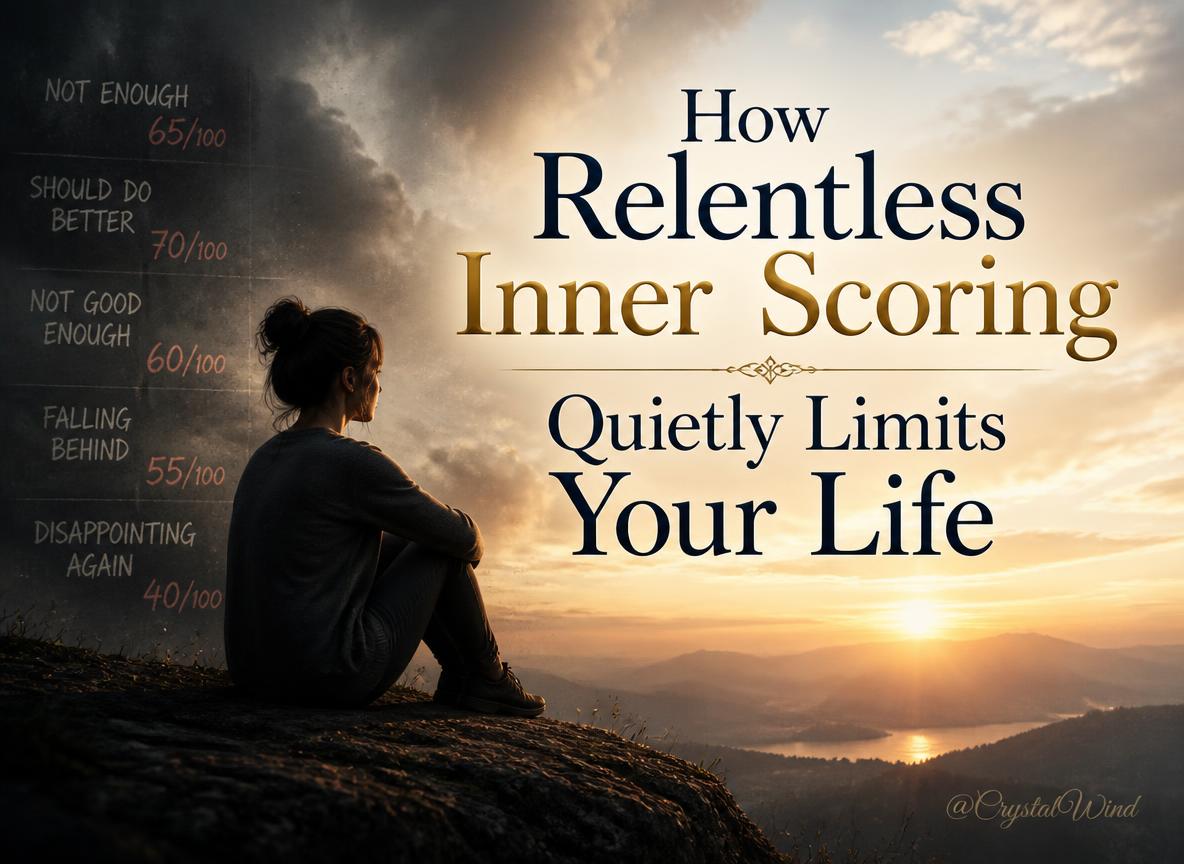
“Discover why curiosity interrupts mental trials” ~Crystal Wind
This piece invites a pause from the quiet courtroom most of us carry inside. Barrett traces how rehearsed standards become mistaken for identity, and how a single day of curiosity can loosen a loop that has been running for decades. What follows is less a self-help prescription than a permission slip to stop prosecuting your own existence.
Read Time: 10 min | Exclusive Publication | Crystal Wind News Service |
There are conversations taking place inside of us that no one else hears.
They happen while we drive, shower, work, look in the mirror, lie awake at night, walk into a room, make a decision, or replay something we said three days ago.
I should have done better.
Why did I say that?
I should be further along by now.
I should know better.
What will they think?
What's wrong with me?
Did I make a fool of myself at that meeting?
Making comparisons between yourself and others at work, strangers or family
For many of us, these conversations have become so familiar that we barely recognize them as judgment. They simply feel like thinking.
Yet imagine another human being following you around throughout the day, constantly evaluating your appearance, decisions, intelligence, progress, mistakes, relationships, age, accomplishments and shortcomings. At some point, we might call that harassment.
And yet we often permit our own minds to do precisely this.
I sometimes think of this as personal mind harassment, which I have brought to the attention of others in workshops.
Perhaps one of the most radical things we can occasionally do for ourselves is not improve ourselves, correct ourselves, analyze ourselves or fix ourselves, but simply take a break from judging ourselves.
Not forever.
Just long enough to notice how much energy we have been spending standing in judgment of our own existence. One may even negotiate with themselves to do this for an hour or one day or longer.
The Judgment We No Longer Hear
Self-judgment doesn't always announce itself dramatically.
It isn't necessarily a voice screaming, You're not good enough.
Often it is much quieter:
You should be doing more.
You're getting too old for that.
You should have figured this out by now.
You can't let people see that side of you.
Why can't you be more like…?
You made another mistake.
It is also important to recognize that our thinking occurs on multiple levels, with several streams of mental processing operating simultaneously. The thought occupying our conscious attention is simply the most prominent—the featured thought—while quieter layers of thought and evaluation may continue beneath it. It is much like a computer with numerous windows open in the background. We may be focused on only one window, but the others are still running and consuming resources, potentially affecting the speed and efficiency of the entire system. Our mental processing can operate in much the same way.
This is important because human beings spend an enormous amount of mental and emotional energy evaluating themselves against standards they may never have consciously chosen.
Where did those standards come from?
Parents. Teachers. Culture. Religion. Education. Social groups. Advertising. Media. Ideas about beauty, intelligence, success, money, productivity, relationships, aging and what a "good" or "successful" life is supposed to look like.
From childhood onward, the brain is learning from its environment. It is detecting patterns, consequences, rewards, threats, approval and rejection. We learn what receives praise. We learn what causes embarrassment. We learn what makes us acceptable and what might result in exclusion.
Eventually, the outside world doesn't have to judge us quite as much.
We learn to do it ourselves.
The Brain Learns the Loop
This is where the neuroscience becomes particularly interesting.
The brain is not simply waiting passively for reality to arrive. It is continuously drawing upon previous experience to interpret what is happening now and anticipate what may happen next.
Our memories, beliefs, emotional experiences and learned expectations therefore become part of the architecture through which we interpret ourselves and the world.
One brain system relevant to this discussion is the default mode network, or DMN. It is involved in self-referential thought, autobiographical memory, imagining the future, thinking about other people and maintaining aspects of our internal narrative.
This isn't a "bad" network. We need it. It helps us maintain a sense of continuity across time: who I was, who I am and who I might become.
But that extraordinary capacity also means the mind can revisit the past, rehearse conversations, imagine future failures and repeatedly return to unresolved questions about ourselves.
Research into rumination suggests that repetitive negative thinking involves not simply one brain region but interactions among systems associated with self-referential processing, emotional salience and cognitive control. In other words, the looping mind has biology behind it.
The problem isn't that we think about ourselves. The problem arises when particular interpretations of ourselves become so rehearsed that they begin to feel like facts.
Familiarity can masquerade as truth.
A thought may have been repeated for twenty years without ever having been seriously questioned.
I'm not smart enough.
I'm terrible with money.
People always leave me.
I'm too old to begin again.
I never finish anything.
I'm not attractive enough.
I can't trust myself.
The brain has encountered the thought so many times that the pathway is familiar.
But familiar does not necessarily mean true.
Who Installed the Measuring System?
This raises a question I find much more interesting than simply asking how we can stop negative thinking:
Who established the standards against which we are measuring ourselves in the first place?
Much of what we call identity is assembled from experience.
Before we were old enough to consciously examine the world, the world was already telling us what things meant.
Success meant this.
Failure meant that.
Beauty looked like this.
Intelligence looked like that.
At this age you should have accomplished this.
At that age you should stop doing that.
Certain careers were respectable. Certain behaviors were embarrassing. Certain dreams were unrealistic.
And because belonging is profoundly important to human beings, these messages can become deeply embedded.
Eventually, an external expectation becomes an internal voice.
And then something even more interesting happens: we may mistake that voice for ourselves.
Another enormous area of judgment is the idea of responsibility. Imagine being repeatedly told throughout your life that you are irresponsible, particularly when that judgment comes from someone whose authority carries tremendous weight, such as a parent. I have seen how deeply this can become embedded. The person may spend years trying to prove that they are responsible, becoming increasingly cautious about taking risks or venturing beyond boundaries that have been defined as safe and “responsible.” What began as someone else's judgment can eventually become an internal guardrail—quietly determining how far we give ourselves permission to go.
This is where taking a break from self-judgment becomes more than an exercise in being nicer to ourselves. It becomes an investigation into consciousness, conditioning and identity.
Whose voice is this?
Where did this belief originate?
Is this actually what I believe?
Or have I simply rehearsed it for so long that it feels like me?
The Judge Looking Outward
There is another side of self-judgment that we don't discuss nearly enough.
We can be extraordinarily judgmental of other people.
We judge how they look, what they believe, how they raise their children, how they spend money, how successful they are, how unsuccessful they are, how they age, what they wear and the choices they make.
Sometimes those judgments may tell us something about the other person.
But sometimes they may tell us considerably more about ourselves.
The brain uses existing models and previous experience to interpret both self and others. Neuroscience research into self-processing and social cognition suggests overlap and interaction between systems involved in thinking about ourselves and understanding other people.
So perhaps some of the standards we apply outwardly are extensions of the standards operating inwardly.
If I have spent my life believing that productivity determines worth, I may become unusually critical of someone I perceive as unproductive.
If I have denied myself permission to take risks, another person's freedom may make me uncomfortable.
If I have learned that aging requires increasing restriction, someone who refuses those restrictions may appear inappropriate.
If I have been taught to suppress particular aspects of myself, seeing another person express those qualities freely may provoke judgment.
This does not mean that every judgment of another person is secretly self-judgment. Human evaluation is far more complex than that.
But it gives us a fascinating question to ask:
What does my judgment of you reveal about the rules operating inside of me?
The harsh judge looking outward may sometimes be the same judge that has been looking inward all along.
What Is All This Judgment Costing Us?
There is an energetic cost to constantly monitoring ourselves particularly in this manner
Not simply in some abstract sense, but cognitively and physiologically.
Repetitive self-focused thinking demands attention. Emotional threat and perceived social evaluation can engage stress-related systems. Rumination can keep emotionally significant material active long after an event itself has ended.
Think about the extraordinary ability we have to react physiologically to something that isn't currently happening.
The conversation ended yesterday.
The person isn't in the room.
The event is over.
Yet we can replay it today and experience anger, embarrassment, fear or shame again.
The body is sitting in the present while the mind has transported itself somewhere else.
And this is where self-judgment becomes more than an unpleasant habit.
It can influence how we construct our lives. If I am continuously judging myself, I may become less willing to experiment.
- Less willing to fail.
- Less willing to be seen learning.
- Less willing to change direction.
- Less willing to risk appearing foolish.
- Less willing to become someone unfamiliar.
We may call this being practical or cautious when, underneath it, an internal judge is quietly determining the boundaries of possibility.
Taking a Break Doesn't Mean Abandoning Discernment
There is an important distinction here. The goal is not to eliminate judgment entirely.
Human beings need evaluation. We need to recognize mistakes, assess consequences, reconsider decisions and learn from experience. There is enormous value in being able to say, I could have handled that differently.
But there is a profound difference between:
"I made a poor decision."
and
"There is something wrong with me."
One evaluates an event.
The other turns the event into an identity.
That distinction matters.
Taking a break from self-judgment doesn't mean refusing responsibility. It doesn't mean pretending everything we do is wonderful. And it certainly doesn't require adopting artificial positive thinking.
It means interrupting the automatic prosecution.
Perhaps instead of immediately deciding whether something about ourselves is good, bad, successful, embarrassing, attractive, appropriate or inadequate, we simply observe it.
Interesting. I notice that I am judging myself again.
And then don't do anything about it for a moment.
Don't correct the thought.
Don't replace it with an affirmation.
Don't argue with it.
Don't build another philosophy around it.
Just notice it.
That small space between the automatic thought and our participation in it may be more powerful than it appears.
Interrupting the Loop
The brain remains plastic throughout life.
Repeated patterns can become increasingly efficient, but they are not necessarily permanent.
Attention matters. Experience matters. What we repeatedly rehearse matters.
Research into mindfulness, self-compassion and related practices suggests that our relationship with self-referential thought is modifiable. We don't necessarily have to prevent a thought from appearing in order to change what happens next.
This is an important distinction.
The goal isn't necessarily:
"How do I stop my brain from producing this thought?"
A more interesting question might be:
"Why must I automatically participate in it?"
The thought appears.
You're not good enough.
Perhaps instead of entering the familiar courtroom and presenting evidence for and against ourselves, we recognize the pattern.
There is that loop.
And we continue with our day.
The brain may offer an old prediction without our being required to build a future around it.
That is where possibility begins to enter the conversation.
What Happens When the Judge Doesn't Get the Final Word?
Imagine taking one day off from unnecessary self-judgment.
Not from discernment.
Not from responsibility.
From harassment.
You look in the mirror without immediately conducting an evaluation.
You make a mistake without turning it into a statement about your worth.
You remember something embarrassing without reopening the trial.
You encounter someone else's success without using it as evidence against your own life.
You notice your age without attaching a list of things you supposedly can no longer do.
You have an idea without immediately explaining to yourself why it won't work.
You simply allow yourself to exist without constantly measuring the quality of your existence.
What might become available in that space?
Perhaps curiosity.
Perhaps energy.
Perhaps creativity.
Perhaps greater tolerance for other people.
Perhaps greater willingness to take risks.
Perhaps the ability to encounter ourselves without immediately consulting the accumulated rules of who we have been told we should be.
And perhaps we begin to discover something else: beneath all that judgment there may be a human being we haven't actually met without commentary.
An Experiment
So rather than turning this into another instruction about how you should improve yourself, I would suggest something simpler.
Conduct an experiment.
For one day, notice how many times you judge yourself.
Don't judge yourself for judging yourself, that would simply create another loop.
Just become curious.
Notice the language.
Notice what triggers it.
Notice whose standards appear to be operating.
Notice whether similar standards emerge when you judge other people.
And occasionally ask:
Is this actually what I believe, or is this something I learned to believe?
Then give yourself permission not to answer immediately.
The objective isn't to become a perfectly nonjudgmental human being.
The objective is to become aware of an internal process that may have been running automatically for decades.
Because perhaps the greatest consequence of incessant self-judgment isn't simply that it makes us feel bad.
"Perhaps its greatest consequence is that it quietly determines the size and shape of the life we give ourselves permission to live."
We spend so much of life attempting to become acceptable to our families, our communities, our professions, our cultures and ultimately to the internalized versions of all of them living inside our heads.
But there comes a point when we might ask:
Acceptable according to whom?
Take a break from the judgment.
Allow the looping brain and mind to loop without automatically following it everywhere it wants to go.
And in the space that remains, perhaps there is an opportunity to hear something beneath all that accumulated noise. Not another instruction about who you should become. But the possibility of discovering who you might be when you are no longer standing in constant judgment of yourself.
Author
 Sonia Barrett Sonia Barrett is known for her cutting edge insights with much of it supported by quantum physics. Theoretical Physicist Dr. Amit Goswami refers to her as a true mystic. Her work bridges the gap between science and spirituality in a simplified format. She addresses the programming, beliefs and concepts by which we have lived our lives both individually and collectively.
Disclaimer: The information in this article is presented for educational and informational purposes only. Views expressed are those of the contributing author and do not necessarily reflect the views of CrystalWind.ca, which makes no claims regarding the accuracy of any content herein.
Explore More
Primary: #Self Judgment web #Inner Critic web #Consciousness web
Related: #Default Mode Network web
Primary: #Self Judgment web #Inner Critic web #Consciousness web
Related: #Default Mode Network web
© 2026 CrystalWind.ca | All Rights Reserved | Awakening Souls Since 2008
Support: Ko-Fi | PayPal
#CrystalWind #SpiritualJourney #Awakening

Enjoyed this article? Continue your journey with AromaWorx – wellness & aromatherapy , and support us at Support Crystal Wind™ .
Share your thoughts below! 























































Support CrystalWind
Free spiritual inspiration since 2008
Help keep CrystalWind free and growing with a small contribution.
Buy us a coffee
Donate with PayPal


Latest Articles


✨ Digital Treasures ✨
The Crystal Wind Oracle
58-card deck • Lisa Iris art • ⭐⭐⭐⭐⭐
58-card deck • Lisa Iris art • ⭐⭐⭐⭐⭐
Crystal Lover's Handbook
67 crystals A–Z • chakras • healing uses
67 crystals A–Z • chakras • healing uses
Alchemy of Consciousness
Shift your reality from the inside out
Shift your reality from the inside out
Messages from the Archangels
Channeled guidance for your path
Channeled guidance for your path
Starseed Field Guide
Your mission • your origins • your tribe
Your mission • your origins • your tribe
Crystal & Mineral Wallchart
50+ stones • quick-reference • printable
50+ stones • quick-reference • printable
Complete Zodiac Collection
12 Lisa Iris prints • frame it • gift it
12 Lisa Iris prints • frame it • gift it
Zazzle Shop
Prints • posters • puzzles • gifts
Prints • posters • puzzles • gifts
Support CrystalWind.ca
Keep the light on • you have our gratitude
Keep the light on • you have our gratitude
✦ CRYSTAL WIND™ NETWORK ✦
- ✦ AscensionPulse.com — Ascension News
- ✦ LisaIris.com — Visionary Art
- ✦ ReikiWorks.ca — Energy Healing
- ✦ AromaWorX.ca — Aromatherapy
- ✦ Universal.net — Connecting the World
- ✦ NoBody.com — Be a Nobody

The Physical Card Deck
Dive into the Mystical World of the Crystal Wind Oracle Deck! Get All the Enchanting Details Now!
Grab Your Deck Now!NEW Expanded Boxed Edition!
Now with 58 Cards for Richer Wisdom!
The Mobile App

Shatter Illusions - Gain Clarity Now!
Instant Access On:
New! 53-Card Deck for Deeper Wisdom
See What Users Are Raving About!



Thank You for Visiting CrystalWind!
We’re honored to be part of your journey.
Let’s grow together!
If this space has been meaningful, support it here.
Featured This Month
Page:


Mabon Magic: Ideas For Fall Decoration And R…

Welcome to the season of Fall! As we turn the Great Wheel toward autumn in t... Read more
Sweet Violet

“Discover how violets awaken faithful heart powers” ~Crystal Wind These quiet... Read more
Harvest Moon

“Discover how these totems foster balance” ~Crystal Wind Standing at the thre... Read more

Virgo Mythology

“Discover why Virgo embodies pure self-sufficiency” ~Crystal Wind The ancient... Read more
The Vine: September 2nd - September 29th

“Discover how swan grace steadies restless hearts” ~Crystal Wind As the wheel... Read more
Sun in Virgo

“Discover how order becomes living grace” ~Crystal Wind This long-form Virgo ... Read more
Virgo's Featured Stone - Sugilite

“Discover how sugilite builds lasting confidence” ~Crystal Wind In the realm ... Read more
Mabon in Modern Times: Fresh Takes on the Au…

The Mabon season begins somewhere around the 21st-22nd of September and cont... Read more
Crystals for Virgo

As the warmth of summer begins to soften into the crispness of autumn, the Sun... Read more
Birth Totem - Bear

“Discover why Bear totem brings deep wisdom” ~Crystal Wind Read Time: 6 min |... Read more
Peridot: The Healer's Stone

Peridot has been used as a Power Stone for centuries. Peridot fosters emotio... Read more
Watermelon Tourmaline

“Discover how rare crystals heal the heart” ~Crystal Wind This rare variety o... Read more