You are here: Home  Pathfinder Inspired Paths Inspired Mind How AI Is Redefining Human Intelligence and Inner Potential
Pathfinder Inspired Paths Inspired Mind How AI Is Redefining Human Intelligence and Inner PotentialHow AI Is Redefining Human Intelligence and Inner Potential
- Details
- Written by Sonia Barrett
- Views: 14515
[READ TIME: 12 min]
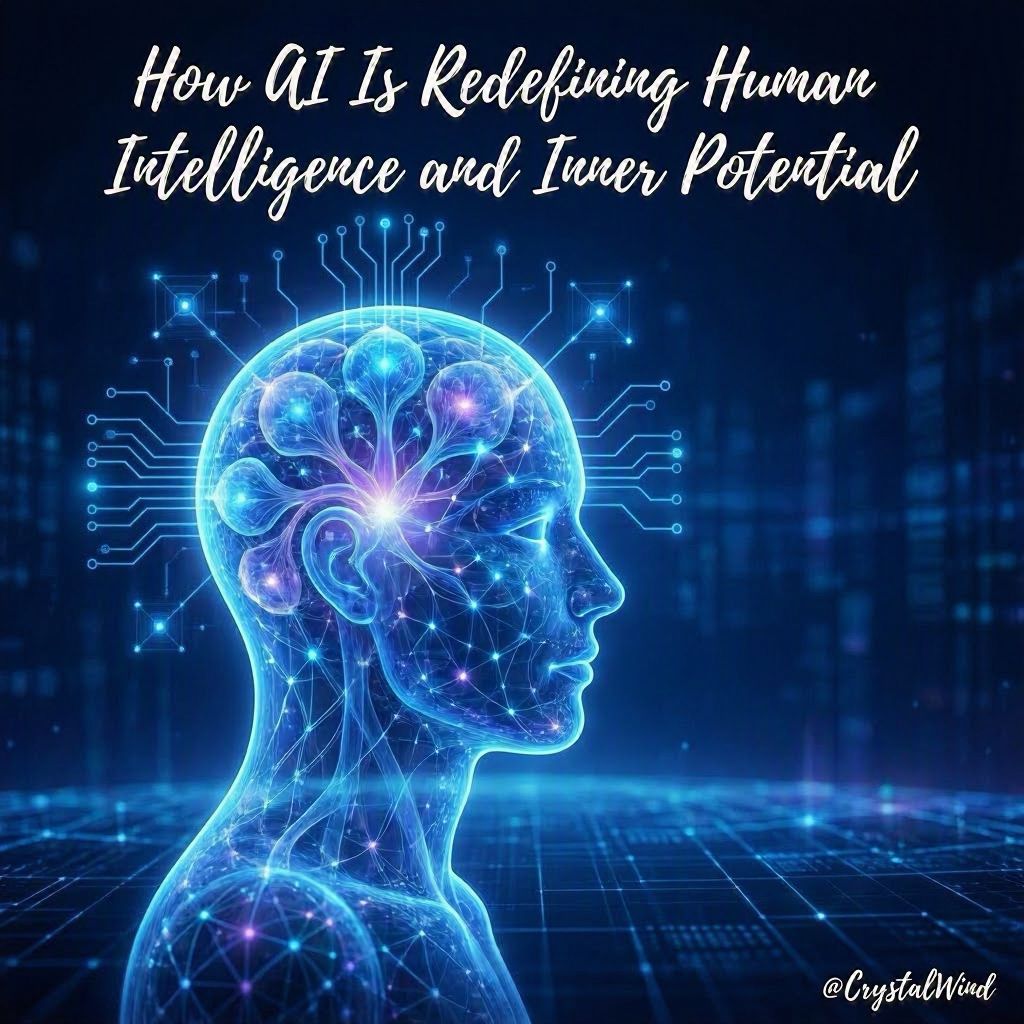
“Discover how intelligence expands beyond artificial limits” ~Crystal Wind
Exclusive Publication | Crystal Wind News Service |
For more than two decades I have explored the relationship between perception, consciousness, technology, adaptation, and human potential. This article continues that inquiry into one of the most significant shifts of our time, the changing definition of intelligence itself.
Dr. Sonia Barrett, Applied Neuroscientist & Architect of Neurorepatterning™
While intelligence has numerous meanings, to realize that the invisible guidepost is continuously being moved, one may become more aware of the subtle suggestions and inferences gradually shaping the narrative of one's life and that of society.
"Intelligence can be defined as the ability to solve complex problems or make decisions with outcomes benefiting the actor, and has evolved in lifeforms to adapt to diverse environments for their survival and reproduction. For animals, problem-solving and decision-making are functions of their nervous systems, including the brain, so intelligence is closely related to the nervous system."
— Annika Weder, What is Intelligence? (2020)
Neuroscience increasingly recognizes intelligence as being far more than the accumulation of information. Intelligence involves adaptability, pattern recognition, emotional regulation, creativity, social cognition, and the ability to generate novel solutions under changing circumstances. While computational systems may surpass humans in specific tasks involving speed, memory, and data analysis, human intelligence remains uniquely connected to consciousness, meaning-making, imagination, subjective experience, intuition, and the capacity to navigate uncertainty.
Society has always experienced the influence of institutions, systems of power, and cultural conditioning. However, life is experienced through periods and ages that usher in specific patterns of human cognition and behavior. We are witnessing such a period now—an upsurge in the designing of intelligence, not only of an artificial kind but of a human one as well.
Everyone is aware of the age of AI and the rise of intelligent technologies. The reality of AI has now been worked into the psyche and reinforced daily through all forms of media and direct interaction. AI is no longer operating quietly in the background. It now participates in writing, research, decision support, education, healthcare, artistic creation, software development, and everyday communication. As a result, society is no longer simply using technology; it is increasingly measuring itself against it.
For more than twenty years, I have written and spoken about the changing relationship between humans, technology, consciousness, and the evolution of perception. Long before artificial intelligence became a household topic, the trajectory was visible. What we are witnessing today is not an isolated technological event but part of a larger evolutionary process affecting how humans define themselves, their value, and their potential.
It is important to pay attention to your intelligence meter and how you now perceive yourself. Notice that with the marketing of Artificial Intelligence, the language surrounding written and verbal information continuously implies an expected level of intelligence that AI will one day achieve—an intelligence projected as eventually surpassing that of humans. People's fear, anger, anxiety, and for some, complacency in doing less because of AI, can unintentionally reinforce the suggestion that humans possess a lesser intelligence than what is expected in the future of machines.
It is a subtle reshaping suggestion. A growing concern among psychologists and educators is not that AI will necessarily diminish human intelligence, but that humans may begin outsourcing too many cognitive functions. Memory, critical thinking, problem-solving, and creativity strengthen through use. Like muscles, cognitive capacities can weaken when consistently underutilized.
Intelligence and creativity, while interconnected, are not identical. They involve different neural networks with overlapping functions. Creativity remains one of the most essential aspects of human growth and transformation. It is imagination that has brought humanity to this point in time. Every invention, scientific breakthrough, artistic expression, and societal transformation first existed as an idea. Humans are repeatedly told of the impossibility of achieving what AI can in processing speed and data capacity. Yet this comparison itself may be misleading. The ability to process vast amounts of information does not automatically equate to wisdom, insight, creativity, self-awareness, or consciousness.
When such comparisons become accepted without question, there can be an automatic relinquishing of possibilities—an unconscious surrender of unapproved forms of human cognitive evolution and revolution.
"If artificial intelligence teaches us anything, perhaps it is not simply what machines can become, but what humans have forgotten about themselves."
Humans are constantly told what they are, who they are, and what beliefs are acceptable. Much of this occurs subtly. So much of what we perceive as natural behavior is actually the result of repeated conditioning, expectations, narratives, and redirects.
Behavioral science has long demonstrated that repeated exposure to ideas can influence perception and behavior. Through processes such as priming and expectation effects, suggestions can shape what individuals believe is possible. When societies are repeatedly exposed to narratives about human limitation and technological superiority, those narratives can quietly become part of collective identity. Humans pride themselves on being in charge of themselves while often remaining unaware of their cognitive surrender. The human species is changing as we move through a cycle involving the restructuring of intelligence itself.
This may be reflected in shifts among younger generations who are navigating unprecedented levels of information exposure, technological immersion, social comparison, and psychological stimulation. While these generations possess extraordinary technological adaptability and social awareness, researchers have also documented increasing rates of anxiety, loneliness, emotional overwhelm, and psychological distress.
Some older individuals have chosen to retreat entirely from technology. Yet complete avoidance may create its own challenges. Adaptation has always been one of the defining characteristics of life. It is not necessarily the strongest species that survives, but often the one most capable of adapting to changing conditions.
Adaptation is how life has thrived on this planet.
From an evolutionary perspective, intelligence has never been a fixed trait. Every major technological shift—from language and writing to the printing press, electricity, radio, television, computers, and the internet—has altered the way humans think, communicate, and interact with their environment.
Artificial intelligence may represent another such threshold.
Not merely a technological evolution, but a psychological one.
Remember that humans are a species built to survive under all kinds of harsh conditions. Throughout history we have adapted, transformed, and reorganized ourselves in response to challenge. The experiences of each generation leave their mark upon the generations that follow. We are constantly participating in the shaping of ourselves as a species.
There should be no fear of AI. Humans are the designers.
The fear that AI will take over is not something that must define this era. AI is here to stay, and perhaps it is here to serve a larger evolutionary purpose. Perhaps AI is not the endpoint of intelligence but a catalyst inviting humans to evolve beyond previous assumptions about themselves.
But first, there must be a realization that this is possible.
Many will willingly exchange the evolution of their own intelligence for what appears to be an easier path. Convenience has always been seductive. Yet human growth has rarely emerged from convenience alone.
AI has its place in human evolution. This all has to be.
The question may not be whether artificial intelligence becomes more capable. The deeper question is whether humans continue cultivating the capacities that inspired its creation in the first place. Curiosity. Imagination. Intuition. Empathy. Adaptability. Self-awareness. These remain among humanity's most powerful evolutionary technologies.
Evolution and revolution occur because of necessity.
We can continue searching outside ourselves for "God," superior beings, saviors, or solutions—or we can awaken to the possibility that what we seek may already exist within us.
Do not be fooled by the sensory experience of the body or by the discomforts you may have carried throughout your life. Your pain, suffering, challenges, and uncertainties count for something. You are an experiencer. You have gathered data through living itself.
And you can decide whether you are complete with a particular form of experience.
Become aware that you have choices. You can sit on the sidelines.
You can accept the narrative of your suggested fate.
Or you can awaken to the realization that you have always been in the driver's seat, the sleeping driver.
No one will judge the choice you make.
Yet becoming aware of this moment in history allows you to walk into your choice with your eyes wide open.
What I am sharing is that being human is not a final destination but a stage in an ongoing process of becoming.
Intelligence has never been fixed. It expands through challenge, adaptation, necessity, creativity, and imagination. As artificial intelligence advances, perhaps the greater invitation is not to compete with technology but to rediscover dimensions of human potential that have yet to be fully explored.
The future may not belong to AI alone.
It may belong to those willing to remember what it truly means to be human while simultaneously evolving beyond what they once believed possible. Being human may be but a brief moment in an ongoing continuum of transformation—a natural progression toward greater expressions of potential unfolding through this body, this mind, and this experience we call life.
And perhaps what we are witnessing now is not merely the rise of artificial intelligence, but the next invitation for humanity to remember its own.
Some may dismiss such thoughts as philosophical speculation, yet philosophy and imagination have always walked hand in hand with discovery. Before there is a theory, there is a question. Before there is research, there is imagination. Before there is evidence, there is the willingness to contemplate what might be possible. Humanity's greatest breakthroughs were first conceived in the unseen landscape of the mind before they emerged into measurable reality.
While some academic scholars may disagree, I suggest that we are far more than we have been conditioned to believe. We may be the wizard behind the cosmic curtain, the ghost in the machine, expressed through a temporarily forgetful form within the material design of these human bodies. We may be both the observer and the observed, the question and the answer, participating in an evolutionary journey that has yet to reveal its fullest expression.
If artificial intelligence teaches us anything, perhaps it is not simply what machines can become, but what humans have forgotten about themselves.
The future may not belong to AI alone. It may belong to those willing to remember what it truly means to be human while simultaneously evolving beyond what they once believed possible. If artificial intelligence teaches us anything, perhaps it is not simply what machines can become, but what humans have forgotten about themselves.
References
- Weder, A. (2020). What is Intelligence? Max Planck Institute.
- Karl Friston – Predictive Processing and Active Inference.
- António Damásio – Emotion, consciousness, and decision-making.
- Michael Merzenich – Neuroplasticity and brain adaptability.
- Daniel Kahneman – Cognitive bias and decision-making.
- Andy Clark and David Chalmers – The Extended Mind and cognitive offloading.
- Geoffrey Hinton – Foundations of neural network architecture.
- World Economic Forum reports on AI, workforce adaptation, and future skills.
Author
 Sonia Barrett Sonia Barrett is known for her cutting edge insights with much of it supported by quantum physics. Theoretical Physicist Dr. Amit Goswami refers to her as a true mystic. Her work bridges the gap between science and spirituality in a simplified format. She addresses the programming, beliefs and concepts by which we have lived our lives both individually and collectively.
Explore More
Primary: #Intelligence web #AI web #Consciousness web
Related: #Human Potential web #CrystalWind #SpiritualJourney
Primary: #Intelligence web #AI web #Consciousness web
Related: #Human Potential web #CrystalWind #SpiritualJourney
Disclaimer: The information in this article is presented for educational and informational purposes only. Views expressed are those of the contributing author and do not necessarily reflect the views of CrystalWind.ca, which makes no claims regarding the accuracy of any content herein.
© 2026 CrystalWind.ca | All Rights Reserved | Awakening Souls Since 2008
Support: Ko-Fi | PayPal
#CrystalWind #SpiritualJourney #Awakening

Enjoyed this article? Continue your journey with AromaWorx – wellness & aromatherapy , and support us at Support Crystal Wind™ .
Share your thoughts below! 











































Support CrystalWind
Free spiritual inspiration since 2008
Help keep CrystalWind free and growing with a small contribution.
Buy us a coffee
Donate with PayPal


Latest Articles


✨ Digital Treasures ✨
The Crystal Wind Oracle
58-card deck • Lisa Iris art • ⭐⭐⭐⭐⭐
58-card deck • Lisa Iris art • ⭐⭐⭐⭐⭐
Crystal Lover's Handbook
67 crystals A–Z • chakras • healing uses
67 crystals A–Z • chakras • healing uses
Alchemy of Consciousness
Shift your reality from the inside out
Shift your reality from the inside out
Messages from the Archangels
Channeled guidance for your path
Channeled guidance for your path
Starseed Field Guide
Your mission • your origins • your tribe
Your mission • your origins • your tribe
Crystal & Mineral Wallchart
50+ stones • quick-reference • printable
50+ stones • quick-reference • printable
Complete Zodiac Collection
12 Lisa Iris prints • frame it • gift it
12 Lisa Iris prints • frame it • gift it
Zazzle Shop
Prints • posters • puzzles • gifts
Prints • posters • puzzles • gifts
Support CrystalWind.ca
Keep the light on • you have our gratitude
Keep the light on • you have our gratitude
✦ CRYSTAL WIND™ NETWORK ✦
- ✦ AscensionPulse.com — Ascension News
- ✦ LisaIris.com — Visionary Art
- ✦ ReikiWorks.ca — Energy Healing
- ✦ AromaWorX.ca — Aromatherapy
- ✦ Universal.net — Connecting the World
- ✦ NoBody.com — Be a Nobody

The Physical Card Deck
Dive into the Mystical World of the Crystal Wind Oracle Deck! Get All the Enchanting Details Now!
Grab Your Deck Now!NEW Expanded Boxed Edition!
Now with 58 Cards for Richer Wisdom!
The Mobile App

Shatter Illusions - Gain Clarity Now!
Instant Access On:
New! 53-Card Deck for Deeper Wisdom
See What Users Are Raving About!



Thank You for Visiting CrystalWind!
We’re honored to be part of your journey.
Let’s grow together!
If this space has been meaningful, support it here.
Featured This Month
Page:
Sun in Virgo

“Discover how order becomes living grace” ~Crystal Wind This long-form Virgo ... Read more

Virgo Mythology

“Discover why Virgo embodies pure self-sufficiency” ~Crystal Wind The ancient... Read more
Harvest Moon

“Discover how these totems foster balance” ~Crystal Wind Standing at the thre... Read more
Sweet Violet

“Discover how violets awaken faithful heart powers” ~Crystal Wind These quiet... Read more
Watermelon Tourmaline

“Discover how rare crystals heal the heart” ~Crystal Wind This rare variety o... Read more

Mabon in Modern Times: Fresh Takes on the Au…

The Mabon season begins somewhere around the 21st-22nd of September and cont... Read more
Mabon Magic: Ideas For Fall Decoration And R…

Welcome to the season of Fall! As we turn the Great Wheel toward autumn in t... Read more
Virgo's Featured Stone - Sugilite

“Discover how sugilite builds lasting confidence” ~Crystal Wind In the realm ... Read more
The Vine: September 2nd - September 29th

“Discover how swan grace steadies restless hearts” ~Crystal Wind As the wheel... Read more
Birth Totem - Bear

“Discover why Bear totem brings deep wisdom” ~Crystal Wind Read Time: 6 min |... Read more

Peridot: The Healer's Stone

Peridot has been used as a Power Stone for centuries. Peridot fosters emotio... Read more
Crystals for Virgo

As the warmth of summer begins to soften into the crispness of autumn, the Sun... Read more