You are here: Home  Eureka! Cosmic Stargate Cosmic Events Geminid Meteor Shower 2025: Viewing Guide & Tips
Eureka! Cosmic Stargate Cosmic Events Geminid Meteor Shower 2025: Viewing Guide & TipsOrionid Meteor Shower - 2022
- Details
- Written by CrystalWind.ca
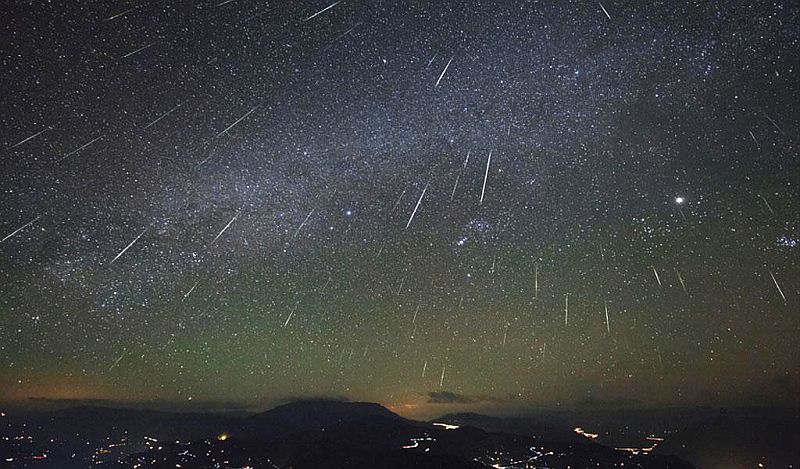
The Orionid meteor shower should peak in 2022 on the morning of October 21-22 under the light of a fairly small waning crescent moon. The Orionid meteor shower will remain active until early November.
On October 25, at 10:49 UTC, there is a new moon. The moon will therefore be in a waning crescent phase and rise in the early morning hours near the Orionids' anticipated* peak. There will be light, but not a lot of it. While keeping an eye out for the Orionids in 2022, you might even enjoy the waning crescent.
When should you watch for Orionid meteors? Meteor showers aren’t just one-night events. The Orionid shower lasts from early October to early November, as Earth passes through a stream of debris left behind by a comet, in this case, the famous Comet Halley. According to the International Meteor Organization (IMO), the Orionids often exhibit several lesser maxima, so meteor activity may remain more or less constant for several nights in a row, centered on a peak night.
The Orionid meteors generally start at late night, or around midnight, and display maximum numbers in the predawn hours. That’s true no matter where you live on Earth, or what time zone you’re in. If you peer in a dark sky between midnight and dawn on October 20, 21 or 22, you’ll likely see some meteors flying.
The particles come from Comet 1P/Halley, better known as Halley's Comet. This famous comet swings by Earth every 75 to 76 years, and as the icy comet makes its way around the sun, it leaves behind a trail of comet crumbs. At certain times of the year, Earth's orbit around the sun crosses paths with the debris.
"You can see pieces of Halley's Comet during the Eta Aquarids [in May] and the Orionid meteor shower [in October and November]," Cooke told Space.com.
Orionid Meteor Shower: Leftovers of Halley's Comet
Typically, the Orionids produce about 20 meteors an hour, but in exceptional years, like 2006 and 2009, they've rivaled August's famous Perseid meteor shower. Cooke expects the shower to produce about 30 or 40 meteors an hour this year. The meteors radiate from the constellation Orion, but can be seen from anywhere in the sky.
The meteoroids from Halley’s Comet strike Earth’s atmosphere at a speed of 148,000mph, (238,000kph) incinerates in fiery flashes of light easily visible with the naked eye.
The Orionids are known for their speed and brilliance, meaning there’s a good chance this with enough patience should see several bright ‘shooting stars’ hurtling across the sky.
Halley’s Comet itself has not been visible from Earth since 1986.
How to view the show
Orionid meteors are visible from anywhere on Earth and can be seen anywhere across the sky. If you find the shape of Orion the Hunter, the meteor shower's radiant (or point of origin) will be near Orion's sword, slightly north of his left shoulder (the star Betelgeuse). But don't stare straight at this spot, Cooke said, "because meteors close to the radiant have short trails and are harder to see — so you want to look away from Orion."
As is the case with most nighttime skywatching events, light pollution can hinder your view of the Orionid meteor shower (although this year, the moon will do damage as well). If possible, get far away from city lights, which can hinder the show. Go out around 1:30 a.m. and let your eyes adjust to the dark for about 20 minutes. Bundle up against the cold if necessary. Lie back and use only your eyes to watch the sky. Binoculars and telescopes won't improve the view, because they are designed to see more stationary objects in the sky
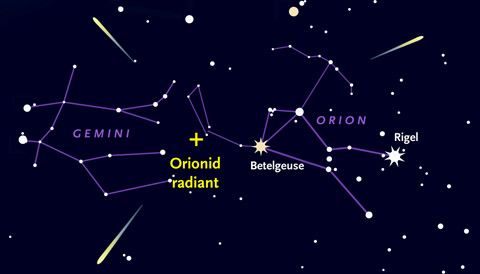
Orionid meteors are visible from anywhere on Earth and can be seen anywhere across the sky. If you find the shape of Orion the Hunter, the meteor shower's radiant (or point of origin) will be near Orion's sword, slightly north of his left shoulder (the star Betelgeuse). But don't stare straight at this spot, "because meteors close to the radiant have short trails and are harder to see — so you want to look away from Orion."
Some Orionids will appear very fast and bright, since they can whiz by at up to 148,000 mph (238,000 km/h) in relative speed. That's just six kilometers an hour slower than the Leonids, the speediest show of the year, Cooke said.
It's tempting to think that the brighter meteors represent fragments that would reach the ground, but Cooke said that isn't the case with the Orionids. These tiny comet fragments — some as small as a grain of sand — are called meteoroids. When they enter Earth's atmosphere, they become meteors. Friction from air resistance causes meteors to heat up, creating a bright, fiery trail commonly referred to as a shooting star. Most meteors disintegrate before making it to the ground. The few that do strike the Earth's surface are called meteorites.
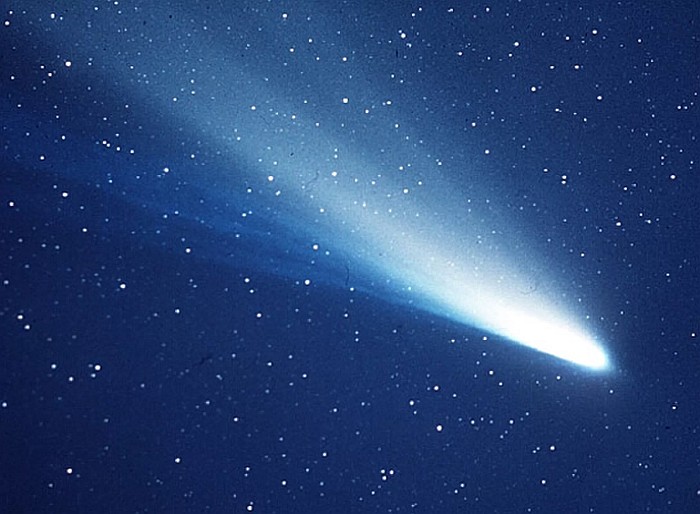
An image of Halley's Comet taken in 1986. Credit: NASA
Cometary origins
Astronomers have recorded Halley's Comet as far back as 240 B.C. but no one realized that the same comet was making multiple appearances. In 1705, then-University of Oxford professor and astronomer Edmund Halley published "Synopsis Astronomia Cometicae" ("A Synopsis of the Astronomy of Comets"), which showed the first evidence that the comet is reoccurring. By studying the historical records of a comet that appeared in 1456, 1531, 1607 and 1682, Halley calculated that it was in fact the same comet and predicted it would reappear in 1758. While Halley died before the comet's return, it did appear on schedule and was named after him.
Reports of the Orionids, however, did not first appear until 1839 when an American in Connecticut spotted the shower, Cooke said. More observations of the shower were recorded during the Civil War between 1861 and 1865. Cooke told Space.com he wasn't sure why the meteor shower was discovered so late, given that records of Halley's Comet exist for millennia.
The next perihelion (closet approach of Halley's Comet to the sun) is expected around July 2061.
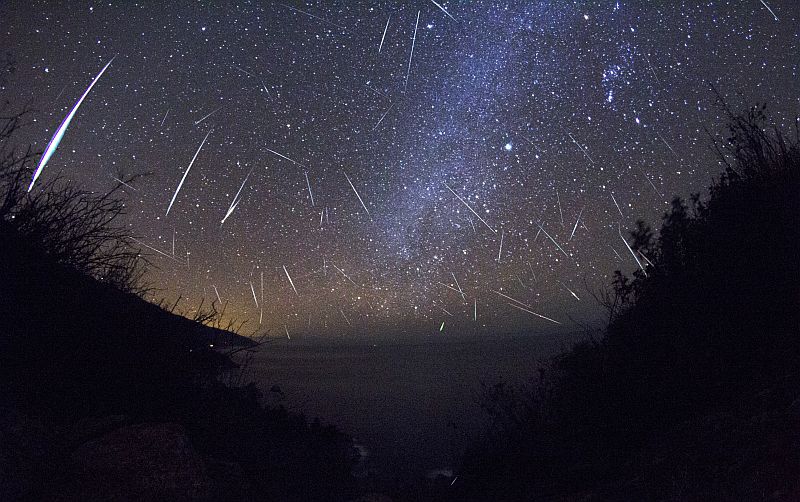
Overall duration of shower: September 26 to November 22.
Bottom line: The waxing crescent moon sets in the evening, providing dark skies for the 2020 Orionid meteor shower. Watch in the dark hours before dawn. Try watching on the mornings of October 20, 21 and 22. A dark sky is always best. Have fun!
© 2022 crystalwind.ca. All rights reserved. We track all IP addresses with sniffer technology. Using a VPN will not hide your IP.

Enjoyed this article? Continue your journey with AromaWorx – wellness & aromatherapy , and support us at Support Crystal Wind™ .
Share your thoughts below! 
Recommended Tools & Resources
As an Amazon Associate we earn from qualifying purchases.
Keep CrystalWind.ca free—your gift matters now!
Help us spread light today. Thank you, supporters!

Support CrystalWind
Free spiritual inspiration since 2008
Help keep CrystalWind free and growing with a small contribution.
Buy us a coffee
Donate with PayPal


Latest Articles


✨ Digital Treasures ✨
The Crystal Wind Oracle
58-card deck • Lisa Iris art • ⭐⭐⭐⭐⭐
58-card deck • Lisa Iris art • ⭐⭐⭐⭐⭐
Crystal Lover's Handbook
67 crystals A–Z • chakras • healing uses
67 crystals A–Z • chakras • healing uses
Alchemy of Consciousness
Shift your reality from the inside out
Shift your reality from the inside out
Messages from the Archangels
Channeled guidance for your path
Channeled guidance for your path
Starseed Field Guide
Your mission • your origins • your tribe
Your mission • your origins • your tribe
Crystal & Mineral Wallchart
50+ stones • quick-reference • printable
50+ stones • quick-reference • printable
Complete Zodiac Collection
12 Lisa Iris prints • frame it • gift it
12 Lisa Iris prints • frame it • gift it
Zazzle Shop
Prints • posters • puzzles • gifts
Prints • posters • puzzles • gifts
Support CrystalWind.ca
Keep the light on • you have our gratitude
Keep the light on • you have our gratitude
✦ CRYSTAL WIND™ NETWORK ✦
- ✦ AscensionPulse.com — Ascension News
- ✦ LisaIris.com — Visionary Art
- ✦ ReikiWorks.ca — Energy Healing
- ✦ AromaWorX.ca — Aromatherapy
- ✦ Universal.net — Connecting the World
- ✦ NoBody.com — Be a Nobody

The Physical Card Deck
Dive into the Mystical World of the Crystal Wind Oracle Deck! Get All the Enchanting Details Now!
Grab Your Deck Now!NEW Expanded Boxed Edition!
Now with 58 Cards for Richer Wisdom!
The Mobile App
Shatter Illusions - Gain Clarity Now!
Instant Access On:
New! 53-Card Deck for Deeper Wisdom
See What Users Are Raving About!



Quake Watch
Articles: The Founders
Articles: Cosmic Neighbours
Articles: Galactic History
Thank You for Visiting CrystalWind!
We’re honored to be part of your journey.
Let’s grow together!
If this space has been meaningful, support it here.
Featured This Month
Page:

Virgo's Featured Stone - Sugilite
“Discover how sugilite builds lasting confidence” ~Crystal Wind In the realm ... Read more
Mabon Magic: Ideas For Fall Decoration And R…

Welcome to the season of Fall! As we turn the Great Wheel toward autumn in t... Read more
Virgo Mythology
“Discover why Virgo embodies pure self-sufficiency” ~Crystal Wind The ancient... Read more
Birth Totem - Bear

“Discover why Bear totem brings deep wisdom” ~Crystal Wind Read Time: 6 min |... Read more
Peridot: The Healer's Stone
Peridot has been used as a Power Stone for centuries. Peridot fosters emotio... Read more
Sweet Violet

“Discover how violets awaken faithful heart powers” ~Crystal Wind These quiet... Read more
Mabon in Modern Times: Fresh Takes on the Au…

The Mabon season begins somewhere around the 21st-22nd of September and cont... Read more
Crystals for Virgo
As the warmth of summer begins to soften into the crispness of autumn, the Sun... Read more


Watermelon Tourmaline
“Discover how rare crystals heal the heart” ~Crystal Wind This rare variety o... Read more
The Vine: September 2nd - September 29th
“Discover how swan grace steadies restless hearts” ~Crystal Wind As the wheel... Read more
Harvest Moon

“Discover how these totems foster balance” ~Crystal Wind Standing at the thre... Read more
Sun in Virgo

“Discover how order becomes living grace” ~Crystal Wind This long-form Virgo ... Read more